EV Charging Station Unveiled in Portland from Mayor Sam Adams
Portland Mayor Sam Adams with people from Beaverton, Metro, PGE and others unveils a new electric vehicle charging station in Portland Oregon. Mayor Adams addresses San Francisco Mayor Gavin Newsom in an electric vehicle infrastructure race that benefits both cities.
Wednesday, April 29, 2009
Plug-in Oregon



NW Solar Expo
 Want to learn how to be a solar installer, or inspector? How about talking to installers about getting a system on your house? The state and federal incentives have never been better, you can get a $20,000 system on your house for just $5,000. If any of the above interests you, then the Northwest Solar Expo and Clean Technology Showcase 2009 is the place to be.
There are lots of seminars with everything from what the Energy Trust of Oregon offers to how to grow your solar business. You can see the full list here.
Solar Professional Training April 28th - 1st
Manufacturer & Dealer Training May 1st - 2nd
Solar Expo Open to the Public May 1st - 3rd
Tuesday, April 28, 2009
Ladies and Gentlemen, Start Your Inverter!
 Our PV system is back online! After being down for 20 days, we are now up and running again.
On April 9th our inverter died after a brief power outage. Busy with other things, I ignored it for over a week, hoping it would just come back. A couple attempts to reboot the system did not work, so we called the pros.
Sarah came out looked at it and ordered a replacement. The replacement arrived (at no cost) and today was install day.
Sarah removed the serial card from the old inverter and plugged it into the new one so that the web box could monitor the inverter and publish the data to the Internet here.
We are back online, let the sunshine!
.jpg)
We are back online, let the sunshine!
I talked to Sarah about inverter failures. Her experience was that about 5% of them fail within the first couple years. Her company now uses SMA and one other brand for inverters because they are, anecdotally, the most reliable. She mentioned a couple other brands that they had used, but they resulted in too many service calls.
.jpg)
Monday, April 27, 2009
Oregon's Power Potential (8/8) Renewable Future
Renewable Energy, Build it Here, Use it Here

Renewable energy opportunities are shining (and raining) down on Oregon and Oregon is not letting them blow by. Oregon has a unique abundance of renewable energy resources. Areas around the Columbia Gorge and in northeastern and southeastern Oregon have excellent wind energy potential. The Oregon Coast has some of the best wave energy sites in the world. Much of eastern Oregon has high potential for geothermal energy. And even the rainiest parts of our state get more sun than Germany, a world leader in solar power. Oregon has made a commitment to renewable energy and there are plenty of opportunities for growth.
As the saying goes "a crisis is a terrible thing to waste." In response to today's economic crisis, Oregon can extend its renewable energy position, improving our local economy, our national security, and our environment.
There are many state programs that encourage renewable energy development, including:
- Oregon Business Energy Tax Credit (BETC) This tax credit is often called “Betsy” for its acronym of BETC, is awarded for 35 to 50 percent of the total cost, depending on the project, for the first $22 million
- The Energy Trust of Oregon (ETO), which provides cash incentives to homeowners, farms, ranches, businesses and government entities install wind, solar and efficiency projects
- The Small Energy Loan Program (SELP), which promotes energy conservation and renewable energy resource development by offering low-interest loans for qualifying projects
- Solar Incentives
Oregon also boasts a high-tech work force with expertise in silicon, the essential ingredient to turn sunlight into electricity. Millions of taxpayer dollars are available to subsidize solar companies. Oregon's Governor expects this to create thousands of jobs in the coming years. So far, the state has snagged photovoltaic giant SolarWorld, which unveiled the nation's largest solar plant, in Hillsboro, and other brands, including Sanyo and Solaicx.
 Oregon's Renewable Future
Clearly wind power is here now and will be expanding rapidly to meet the 2025 target of 25% renewable energy. Wave and geothermal have great promise. Solar too has great potential and can be used in distributed micro-generation PV as well as large scale solar thermal.
Imagine what could be possible by 2025: the wind power all along the North of the state following the Gorge; Wind and wave along the coastline; Solar is scattered across most rooftops with power being generated right where it is used; Geothermal and solar thermal plants east of the Cascades generating power that can be transferred to where ever it is needed or sold to ever-hungry California when there is surplus. Oregon currently has the political will to make this a reality.
Cheap, Abundant, and Clean. It is Possible.
Story Index:
External Links:
Wave (2)Sunday, April 26, 2009
Oregon's Power Potential (7/8) Biomass
Biomass Energy
 Biomass energy is burning plant and organic matter to generate electricity. The biomass may be burned directly or converted into another fuel like pellets or gas before being burned. Biomass sources include wood, landfill gas, manure, and municipal solid waste.
Currently, Oregon has biomass plants located near existing timber operations. They harvest the otherwise unusable scraps and sawdust.
Proponents claim this decreases forest fire danger and that wood burning biomass is carbon neutral because it is not fossil CO2 and the released CO2 is re-absorbed into nearby trees.
Sorry, it is not carbon neutral. The released CO2 was not in the atmosphere, and now it is. That is not carbon neutral. I have a fundamental problem listing the burning of trees as a sustainable method of energy production. I'd prefer to see these scraps used in cardboard, particle board or another product.
Proponents claim this decreases forest fire danger and that wood burning biomass is carbon neutral because it is not fossil CO2 and the released CO2 is re-absorbed into nearby trees.
Sorry, it is not carbon neutral. The released CO2 was not in the atmosphere, and now it is. That is not carbon neutral. I have a fundamental problem listing the burning of trees as a sustainable method of energy production. I'd prefer to see these scraps used in cardboard, particle board or another product.
As for harvesting landfill gas and livestock manure gases - these are "free" by-products of the existing industry's. Burning these gases converts the gas from methane to CO2. Methane is a much more harmful greenhouse gas. So go ahead and burn it and make some electricity.
Biomass is obviously not a method that can be scaled to solve any significant portion of our growing power needs, but taking advantage of it where there are 'free' methane sources is smart.
Saturday, April 25, 2009
Oregon's Power Potential (6/8) Wind
 Wind
Wind
 Wind is clearly the renewable power source that has been growing the fastest. There are plans to build a massive 909 MW wind farm in Oregon. When completed in 2012, the facility will be one of the largest wind power sites anywhere in the world. The wind-rich area of Oregon has become known as one of the country’s ‘bread-baskets’ of wind energy. Oregon might be looking to take that #2 spot from Texas on the list of the nation’s leading producers of renewable energy.
The installation will be located in a 30-mile radius area in Morrow and Gilliam counties in North-Central Oregon. It will use 303 wind turbines; each one 3MW. The project, called Caithness Shepherd’s Flat, will generate an estimated two billion kWh (2 Terawatt-hours) of energy annually.
Offshore Wind
 Offshore wind turbines are generally secured directly to the ocean floor. Along the Oregon coastline, the ocean gets deep quickly. This means that traditional offshore turbines would not be practical here. However, since wave energy projects would be installing the cabling infrastructure to move the energy into the grid, one idea that is being 'floated' is to add floating offshore wind turbines. This expands the scope of the wave energy projects.
 This was a controversial proposal for the little coastal town of Garibaldi. Fisherman, environmentalists, regulators, and people worried about the view all voiced their concerns at an October 2008 meeting.
Friday, April 24, 2009
Oregon's Power Potential (5/8) Geothermal

Geothermal “the forgotten renewable”
Instead of burning fossil fuels to generate steam to turn a turbine, geothermal taps into the Earth’s natural heat to create energy.
Geothermal has the advantage of being a steady source. It is not intermittent like wind and solar. Roughly two-thirds of the initial costs comes from drilling. However, once built, it has no fuel costs.
With backing from google.org's "RE less than C" project research in geothermal has advanced. Now it is possible to extract power from lower temp wells than it was previously. That makes geothermal viable in more areas.
Looking at the geothermal map above, you can see that most of Oregon east of the Cascades is a prime candidate for geothermal.
Thursday, April 23, 2009
Oregon's Power Potential (4/8) Wave & Tidal

Wave Power / Tidal
The Oregon wave power projects convert the Pacific Ocean's heavy rolling swell into renewable energy. Buoys harness the near constant rise and fall of waves.
One type of power buoy, is tethered to the ocean floor so the buoy shaft remains fixed in place, as the outer section bobs up and down in the water. That motion, coupled with magnets and copper coil, generates electricity. Another type is a long snake type. The waves flex the snake and the joints generate electricity. These are being used in Portugal. The ominously named Wave Dragon type has long arms that extend out to concentrate wave energy were the water can be dropped through a turbine much like a hydroelectric dam. These are currently being used in Norway. One tidal type is a man-made blowhole that forces air through a turbine. These are currently being used in Scottland.
Oregon's spectacular coastline could become the United States' center for wave energy development. Two demo projects are underway. If expanded, wave power could generate much of the state's future energy needs.
Wave harnessing was proposed in the August 1932 edition of Modern Mechanix. Globally, wave energy is now undergoing a revival not seen since the OPEC energy crisis of the 1970s. At that time, ocean energy (wave and tidal) enjoyed a brief period of attention, as oil supplies slumped and the price of crude skyrocketed. However, interest waned as prices for fossil fuels dropped and incentives to develop alternative energy supplies evaporated. "Wave energy is still in its infancy," said Justin Klure, a senior energy advisor for Oregon Department of Energy. "In order for ocean energy resources to be viable, advances need to be made in the technology and wave energy must be made affordable to consumers.”
Wave harnessing was proposed in the August 1932 edition of Modern Mechanix. Globally, wave energy is now undergoing a revival not seen since the OPEC energy crisis of the 1970s. At that time, ocean energy (wave and tidal) enjoyed a brief period of attention, as oil supplies slumped and the price of crude skyrocketed. However, interest waned as prices for fossil fuels dropped and incentives to develop alternative energy supplies evaporated. "Wave energy is still in its infancy," said Justin Klure, a senior energy advisor for Oregon Department of Energy. "In order for ocean energy resources to be viable, advances need to be made in the technology and wave energy must be made affordable to consumers.”

Due to the prevailing winds, waves are more powerful on the west coast of the continent. Along Oregon's 460 kilometers of open coastline, waves average 1.5 meters high during the summer months and 3.5 meters during the winter. This makes Oregon an ideal location for wave power. Electrical engineers at Oregon State University (OSU) are developing buoys that can withstand the elements and that they believe will be a key component in affordable clean power. With the development of OSU prototypes and plans for a wave farm near Gardiner some hope our state becomes the center for this nascent industry.
The Oregon coast's paucity of sunshine also makes wave technology appealing to state regulators. When compared to wind and solar power, waves are more consistent. Water is 800 times denser than air so the amount of energy extractable from ocean power is an order of magnitude greater. Some wave proponents claim that harnessing just 0.2 percent of the ocean's energy would meet the entire planet's power needs. Just the with the extraordinary solar claims, this is likely a theoretical statement that ignores many of the real problems of collecting and transmitting the energy, but it does make the point that there is a massive untapped potential.
Incoming swell can be predicted with 80 percent accuracy. A modest sized plant of 200 buoys could illuminate all of downtown Portland. Clearly there is an opportunity for Oregon here.
Wednesday, April 22, 2009
Oregon's Power Potential (3/8) Solar
Solar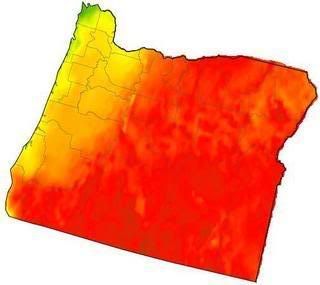
The University of Oregon Solar Energy Center reports that solar energy is, by a substantial margin, Oregon’s most abundant energy resource. Some solar advocates claim that solar's capability to produce electricity, heat and light exceeds that of all other energy resources in Oregon - including hydro and wind. This seems to ignore factors of collection and transmission. Even if it is hyperbole, it does make the point that the rainy Oregon has a massive potential for solar power that is often overlooked.
When most people think of Or-e-gone, they think about rain. That impression comes from the heavily populated NW corner (my corner) of the state. Approximately 60 percent of Oregon is desert, receiving less than seven inches of rain annually. The picture to the right is a solar energy resource map for state for the month of July. While this picture is a little less sunny in December, the state boasts annual solar energy exceeding most of Europe, Japan, New England, the Middle Atlantic States south to Virginia, and the upper Midwest. Solar is clearly an option for Oregon. Some large projects have been proposed for the Eastern desert areas.
When most people think of Or-e-gone, they think about rain. That impression comes from the heavily populated NW corner (my corner) of the state. Approximately 60 percent of Oregon is desert, receiving less than seven inches of rain annually. The picture to the right is a solar energy resource map for state for the month of July. While this picture is a little less sunny in December, the state boasts annual solar energy exceeding most of Europe, Japan, New England, the Middle Atlantic States south to Virginia, and the upper Midwest. Solar is clearly an option for Oregon. Some large projects have been proposed for the Eastern desert areas.
Solar can be harvested either as solar-thermal or as photovoltaic. Solar-thermal uses mirrored troughs to heat oil or salt brine. Another uses concentrating mirrors to a tower. This is then used to boil water. Once heated the thermal mass of the brine means that passing clouds do not cause power spikes and power can often be generated 5-6 hours after the sun goes down.
The drawback for solar is that the population centers are in the NW corner of the state, the one area where solar is the least abundant.
Tuesday, April 21, 2009
Oregon's Power Potential (2/8) Hydro
Hydroelectric
Before discussing the other renewables, Oregon's existing hydro is important to understand. There are 14 major dams on the Columbia and Snake Rivers and over 20 hydroelectric dams in Oregon. As mentioned in part 1, these generate over two thirds of the state's energy.
Hydro is an excellent complement to variable renewable power such as Wind and Solar because hydro generation is relatively easy to manipulate. This allows Oregon a flexibility in power generation that many other areas do not have.
Despite hydroelectric being CO2 free, there are still environmental concerns. These concerns have spurred the “Save Our Wild Salmon” and “Breach the Dam” campaigns.
Portland General Electric (PGE) is looking into expanding hydroelectric energy generation via small hydrokinetic projects. These are turbines that are installed directly in streams, canals or rivers. "You can think of them as underwater wind turbines.", said John Esler, PGE's project manager for hydro licensing. They are less disruptive to fish and landscape, while still growing the renewable power base.
The Federal Energy Regulatory Commission has called for utilities to boost the nation's hydro capacity by 90 gigawatts over the next 10 or 15 years through upgrades to existing dams and hydrokinetic development. A two-year extension of the production tax credit in the economic recovery act also encourages development of hydrokinetic projects.
Monday, April 20, 2009
Oregon's Power Potential (1/8)

Looking at Oregon in the context of energy, you'll see that the state is missing a few things. It does not have coal mines, natural gas, or oil. For Oregon to produce power based on these fossil fuels, they must be brought into the state. Given this lack of fossil resources, it may not be too surprising to learn that Oregon is the third largest renewable energy producing state in the U.S. California and Texas (surprise) hold the #1 and #2 spots.
Hydroelectric power is Oregon's predominant source of electricity, accounting for about 70% of the yearly total (according to energy.gov). About 42% of standard residential power comes from hydro. The majority of the balance comes from Coal and Natural Gas. Oregon has a growing wind and other renewable projects.

The image to the right shows many of the proposed and operational renewable energy projects. You can see that wind power projects along the Columbia Gorge outnumber other projects.
In 2007 the Oregon legislature passed the Renewable Energy Act (SB 838). This law requires that by 2025, the state's major utilities harvest at least 25% of their (non-hydro) energy from renewable sources.
Where are these renewable electrons going to come from? We'll look at what potential the state has for solar, wind, wave, and (don't forget) geothermal. You can expect to see many more entries on the image above to get to 25% renewable.
Sunday, April 19, 2009
AAA Great Battery Roundup
 All this month, AAA Oregon approved facilities will accept, at no cost, used automotive or marine lead-acid batteries. These batteries will be recycled into new batteries.
The lead is 100% recyclable. It is toxic and recycling it will keep it out of our environment. Each car lead-acid battery contains 18 to 21 pounds of lead, ~3 pounds of plastic and ~1 gallon of sulfuric acid, all of which can be reprocessed into new batteries.
Approximately 96 percent of vehicle batteries are recycled. This is more than any other consumer material; more than glass, aluminum, or tin. However, the remaining 4 percent adds up to millions of pounds of lead and gallons of sulfuric acid. These can be discharged into the environment, creating health and safety hazards for humans and animals, as well as a potential fire hazard.
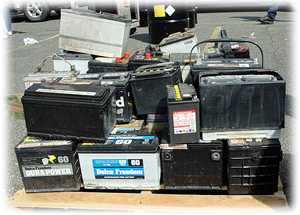 When handling and moving batteries follow basic safety procedures:
- Wear gloves and safety glasses
- Keep the batteries upright and transport them in a sturdy box or plastic container
- Make sure the batteries do not tip over in a moving vehicle
- If the battery is cracked or leaking, place it in a leak-proof container
- Do not smoke near the battery or expose it to an open flame
Saturday, April 18, 2009
Solar Outage Part 2
 Our solar installer, Sarah, came out and checked out the inverter on Friday. It is kaput. Despite the inverter saying otherwise, the grid power was fine. The grid has the correct frequency and both line voltages were well within tolerance. This means the problem is in the inverter. Luckily the inverter is still within the warranty period, so we are getting a new inverter at no cost.
Thursday, April 16, 2009
Solar Outage
 |
When the Sun explodes all PV solar electric systems on Earth will stop operating. Our PV system has stopped working for other reasons. We had a brief power outage and our inverter has not worked ever since. It is still covered under warranty and should be able to handle a brief blackout.
For the record, our star will not explode. It will cool and expand, eventually engulfing our planet. But that is not as funny on a sign.
I have rebooted the Inverter a couple times with no luck. It reports the error code "Disturbance FAC-BRC". Looking up this error code in the manual, it says that the incoming grid frequency is outside of tolerance range. I plugged in our Kill-a-watt meter and it reports that the AC frequency is 59.9 Hertz. It is not 60.0, but that seems like it should be within tolerance. So I have called our Solar installer and they are going to come out and look at it. Until then, the solar panels will be offline.
Sunday, April 12, 2009
Electrathon Races
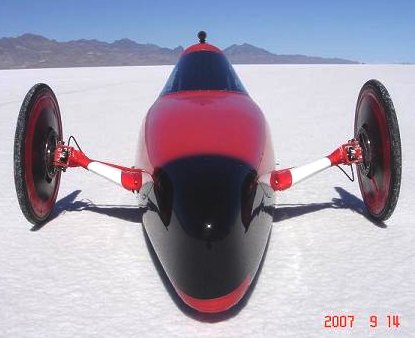
An Electrathon is a timed distance race (marathon) in an electric vehicle. Electrathon America holds events all around the USA. The vehicles are single occupant, ultra efficient (lightweight & aerodynamic), and battery powered.
If you are in the North West USA there several Electrathon races scheduled for this spring & summer. Most of the cars are student designed and built in various classes at around 30 schools in Oregon Washington.
- April 18th at LCC in Eugene, OR at 11AM
- April 26th in Pasco, WA at the Columbia CC at 11AM
- May 2nd in Lacey, WA at the Lacey Grand Prix and Alternative Energy Fair
- May 9th in Springfield, OR
- May 16th at Clark Skill Center in Vancouver, WA (tentative)
- May 23rd and 24th is at Portland International Raceway (PIR)
- June in Mapelton, OR (to be scheduled)
- July 18th and 19th in Corvallis, OR as part of the Da Vinci Days
- September 5th and 6th in Eugene, OR at Valley River Center as part of the Eugene Celebration
If you want more details or you are elsewhere in the US, you can find your local events and details at Electrathon America.
Electrathon America
Oregon Electric Vehicle Association
Friday, April 10, 2009
Seamless Solar
 Photo: Energy Peak
The solar PV system shown above integrates thin-film solar directly into the metal roofing. A system like this serves double duty and offers savings in labor and materials. Systems of this type range in size from 3kW to over 100kW.

Continuing the solar roof theme, Lumeta Solar makes the S Tiles, shown above. It integrates into existing roofs.
Each tile has 28-watts of PV and the wires are hidden under the tiles, where they are protected from the weather and from view. The solar tiles piece together using standard quick connectors.
Lumeta also makes Solar Flat Tiles that integrate with concrete and clay flat tile roofs.

Tuesday, April 7, 2009
2025 Vision of the Future
 One sure thing about predictions of the distant future is they will be wrong. A simple search for predictions about the year 2000 from the 1960s will tell you that we all should be driving around in flying cars and have personal servant androids by now. However, regardless of this seemingly fatal failure, predictions can serve to inspire us to create a brighter future, even if we change course a few times along the way. Without such visions to drive innovation, things would move slowly indeed.
Below I present to you a vision of 2025. A future centered on the Smart Garage, how it impacts energy, transportation and you. This vision and the report it kicks off summarizes the results of the Smart Garage Charrette. The event was convened by Rocky Mountain Institute in October of 2008 in Portland, Oregon and included 25 leading organizations.
It's 2025. The world has changed—and the change was driven by what and how we drive. Fossil fuels are loosening their grip on the economy, carbon emissions from our transport and electricity are falling in absolute terms, and a dramatic shift in engineering design has given the devices, buildings, and machinery we use in our daily lives a pervasive emphasis on energy efficiency. Our vehicles are no exception. In 2025 they run, for the most part,on silent electric drivesystems powered by clean electricity.
A typical day might go something like this: after work, you drive home in your plug-in hybrid, pull into the garage, and connect your vehicle to a power cord that connects to your house. Your car and house “shake hands”—the car tells your house the state of its battery, and the house’s energy management system figures out how best to charge your car. The car then spends part of the night recharging on cheap electricity that comes from a new big wind farm. In fact, your car charges in sync with how fast the wind is spinning the turbines—guaranteeing you are only getting “green” electrons. In the morning, you check your home energy dashboard to review the status of your car’s charge, and you happily drive to work in your vehicle, which uses electricity most of the time. If your commute takes a few extra turns, an efficient little biofuel, gasoline, or diesel engine comes on to provide extra range.
You get to work, drive into the parking lot, and plug your car into another electric charging system. It automatically recognizes your car and links to your credit card and your utility account. Your car and utility share information in both directions—how much electricity the battery has or needs, how much it costs (now and perhaps later in the day). Based on the preferences you previously set online, your car and utility decide the best, cheapest, and greenest way to get the energy your mobility requires.
Say it’s a hot summer day, and electricity is in high demand and more expensive. Based on your preferences, the utility and the vehicle converse. The car declines the day’s charging because the price is extremely high. In addition, the utility would prefer to draw power from the car and pay its value back to your credit card. The price is right, so your car, seeing a juicy “carbitrage” opportunity, decides to use its electrical storage to earn you some money. At 5 p.m., you climb into your pleasant, pre-cooled car and drive home mostly on advanced, environmentally-friendly biofuel.
Your cousin, meanwhile, lives in the city and owns a 150-mile-range fully electric vehicle, which can cover almost all of her driving needs. She charges mostly overnight, like you, but her apartment’s garage has set up charging stations. Better, she gets her fuel for free: the building’s garage works with the utility to provide “grid services” from the parked cars to subsidize the free charging—while also enabling the utility to put more wind on its grid. On those weekends when she takes a trip to the ‘burbs for shopping, she’s goes to a big-box retailer that has free fast-charge stations. Her car is charged while she shops and the power comes from the retailer’s rooftop solar array (in fact, due to this array and its efficient design, this store is a “net-zero” energy building). Since the charging service draws her to the store for a set period of time, it is worth it to the retailer to provide free charging. Your cousin is able to drive without paying a cent for energy—unheard of a decade earlier in 2015 when oil spiked at more than $200 a barrel.
Bringing electrified vehicles, advanced net-zero buildings, and a smart renewable grid together in innovative ways to provide clean, cheap mobility and electricity: that is the vision of Smart Garage.
Links:
Saturday, April 4, 2009
Renewably Powered Transportation
Sherry Boschert, author of Plug-in Hybrids: The Cars that Will Recharge America, talks about the benefits of plug-in transportation. It is cleaner, cheaper, and domestic (no war required), she explains. How did Sherry become a Plug-in advocate? After installing solar panels, she started looking for ways to use this great clean, renewable power she was generating; her answer, rather than storing it in stationary batteries, put it in the mobile batteries of an electric car.
This talk is now nearly a year old, so a couple of the references are dated, but all of the ideas are still relevant.
"Plug-in Hybrids is a must-read. If you are concerned about the environment, national security, or high gas prices, there is a solution and it's contained in this book. But this isn't simply a book about cars, it's a book about our future. And our future started to look brighter with every page I turned. I was riveted."
- Alexandra Paul, EV driver
Link
SherryBoschert.com
- Alexandra Paul, EV driver
Link
SherryBoschert.com
Wednesday, April 1, 2009
March 2009 PV & EV Report
 March 20th was the Vernal Equinox. There are now more hours of daylight than darkness each day here in the northern hemisphere, an important milestone on the solar power calendar. And our March results show this, generating 64% more energy than Feb.
You can see in the sunrise time chart below, that here, at 47 degrees north, the first 12 hours of daylight actually occurred two days before the equinox. And it was a great day for solar production; the 18th was one of the better days of the month, out performing the Equinox by a factor of 3.
The 18th also happened to be the day the pond water temp went above 50 degrees F, so now the Koi are out of hibernation and demanding food.
Days of note:
3/18 (first day w/ 12 hour of daylight) = 15 kWh
3/20 (Vernal Equinox) = 5 kWh
3/29 (highest March production day) = 17 kWh
Solar Production:
March total = 274 kWh
Peak power = 3.1 kW on 3/22
Total Energy Production since power on = 4.5 Megawatts
March EV driving

As for my EV driving. I logged 486 miles in the Chevy s10 Electric. This used an estimated 340 kWh of electricity.
The solar panels 274 kWh were not enough to fully fuel my 340 kWh of driving this month. It should be close in April and this summer will wipe all deficits away.
March 2009
Beaverton, Oregon
Beaverton, Oregon
| Sunday | Monday | Tuesday | Wednesday | Thursday | Friday | Saturday | ||
| 1 Sunrise: 6:50am Sunset: 5:57pm Moonrise: 8:25am Moonset: 11:54pm | 2 Sunrise: 6:48am Sunset: 5:58pm Moonrise: 8:57am Moonset: none |  3 3Sunrise: 6:46am Sunset: 5:59pm Moonrise: 9:39am Moonset: 1:09am First Qtr: 11:46pm | 4 Sunrise: 6:44am Sunset: 6:01pm Moonrise: 10:34am Moonset: 2:20am | 5 Sunrise: 6:42am Sunset: 6:02pm Moonrise: 11:41am Moonset: 3:20am | 6 Sunrise: 6:41am Sunset: 6:04pm Moonrise: 12:57pm Moonset: 4:10am | 7 Sunrise: 6:39am Sunset: 6:05pm Moonrise: 2:18pm Moonset: 4:48am | ||
Sunrise: 7:37am Sunset: 7:06pm Moonrise: 4:39pm Moonset: 6:19am | 9 Sunrise: 7:35am Sunset: 7:08pm Moonrise: 5:57pm Moonset: 6:44am |  10 10Sunrise: 7:33am Sunset: 7:09pm Moonrise: 7:14pm Moonset: 7:06am Full Moon: 6:38pm | 11 Sunrise: 7:31am Sunset: 7:10pm Moonrise: 8:28pm Moonset: 7:26am | 12 Sunrise: 7:29am Sunset: 7:12pm Moonrise: 9:42pm Moonset: 7:47am | 13 Sunrise: 7:28am Sunset: 7:13pm Moonrise: 10:54pm Moonset: 8:09am | 14 Sunrise: 7:26am Sunset: 7:14pm Moonrise: none Moonset: 8:34am | ||
| 15 Sunrise: 7:24am Sunset: 7:16pm Moonrise: 12:04am Moonset: 9:04am | 16 Sunrise: 7:22am Sunset: 7:17pm Moonrise: 1:11am Moonset: 9:40am | 17 Sunrise: 7:20am Sunset: 7:18pm Moonrise: 2:13am Moonset: 10:23am |  18 18Sunrise: 7:18am Sunset: 7:20pm Moonrise: 3:06am Moonset: 11:15am Last Qtr: 9:48am | 19 Sunrise: 7:16am Sunset: 7:21pm Moonrise: 3:51am Moonset: 12:13pm | 20 Sunrise: 7:14am Sunset: 7:22pm Moonrise: 4:28am Moonset: 1:16pm | 21 Sunrise: 7:12am Sunset: 7:24pm Moonrise: 4:58am Moonset: 2:22pm | ||
| 22 Sunrise: 7:11am Sunset: 7:25pm Moonrise: 5:22am Moonset: 3:29pm | 23 Sunrise: 7:09am Sunset: 7:26pm Moonrise: 5:44am Moonset: 4:37pm | 24 Sunrise: 7:07am Sunset: 7:28pm Moonrise: 6:04am Moonset: 5:45pm | 25 Sunrise: 7:05am Sunset: 7:29pm Moonrise: 6:23am Moonset: 6:56pm |  26 26Sunrise: 7:03am Sunset: 7:30pm Moonrise: 6:42am Moonset: 8:08pm New Moon: 8:07am | 27 Sunrise: 7:01am Sunset: 7:31pm Moonrise: 7:03am Moonset: 9:23pm | 28 Sunrise: 6:59am Sunset: 7:33pm Moonrise: 7:28am Moonset: 10:40pm | ||
| 29 Sunrise: 6:57am Sunset: 7:34pm Moonrise: 7:59am Moonset: 11:58pm | 30 Sunrise: 6:55am Sunset: 7:35pm Moonrise: 8:39am Moonset: none | 31 Sunrise: 6:53am Sunset: 7:37pm Moonrise: 9:30am Moonset: 1:11am |
| Courtesy of www.sunrisesunset.com Copyright © 2001-2006 Steve Edwards All information presented here is believed correct, but is not guaranteed. |
Subscribe to:
Posts (Atom)