Tuesday, December 29, 2009

Solar Powered Eye

Powering Electronic Contact Lenses and Retina with Sunlight


Scientists are creating augmented reality contact lenses, they have also been working for some time on electronic implants for people losing their photoreceptor cells on their retina. But exactly how might the devices be powered? Stanford scientists have figured out that the very same light entering our eyes that we use to see can be used to power the devices.

The scientists figured out that near infrared light can be both the the power source and data signal for electronics embedded into eyes and electronic contact lenses. The implant that allows them to do this magic is only 3mm wide, and 30 micrometers thick.

IEEE states, "The Stanford implant is designed as an array of miniature solar cells. The device--technically a subretinal implant, because it is placed behind the retina--is part of a system that includes a video camera that captures images, a pocket PC that processes the video feed, and a bright near-infrared LCD display built into video goggles. The pulsed 900-nanometer-wavelength image that shines into the eyes is enough to produce electricity in the chip."

While technically very complicated, over all it's a simple solution - Solar powered eyes for those suffering from progressive loss of photoreceptor cells. The vision wouldn't be perfect - in the best-case scenario, a photovoltaic prosthesis would be good enough only for face recognition and for reading large fonts. But that's certainly better than nothing. So far, there is no projection on when this technology would be available.


via treehugger

Sunday, December 20, 2009

Earth and Sun and Moon


I recently read a story about research to use Helium-3 from the Moon for fusion power. Helium-3 is a non-radioactive element that is rare on Earth. However, it is abundant on the Moon. If we ever wanted to use it to generate energy, this has, among other things, the obvious complication of moving the helium-3 (or the energy) from the Moon the Earth. This is just research and not going to be a cure to our energy issues anytime soon, if ever. But it did provoke an interesting thought.


Would this be the first lunar source of power that we could harness? No. At least to a small degree, we collect lunar power today with wave and tidal power. And furthermore, helium-3 is caused by the solar winds interacting with the lunar surface, so it is actually an embodied form of solar power.

Drat, what I thought was the first Moon power source was neither the first, nor from the moon.

What are the original sources of all of the energy that we use today? I propose that they all originate from one of three sources: The Earth, the Sun, or the Moon.

We have already covered wave and tidal energy from the Moon's pull on our oceans.

Geothermal and hot springs are an energy sourced from the Earth's fiery core. Some chemical energy could be Earth sourced too. More on that below.

Fossil Fuels are biological matter that were trapped and converted by bacterial processes, heat and pressure. This is true for crude, coal, and natural gas (methane). The majority of the biological matter would have been fed from the food chain and so is originally sourced from the Sun with Earth processing for the heat and pressure.

From the Sun more directly we derive photo-voltaic and solar thermal energy. Other sun sources include plant matter including biomass and plant, animal, & algae oils and even a simple campfire.

Hydro power harnesses the water cycle, this is primarily driven by water evaporated by the Sun.

Lightning: This is an interesting one. It is not harnessed, but you can't deny that it is powerful. Lightning is caused by weather, therefor this is a result of the Sun.

Chemical energy could be either Sun or Earth sourced. It depends on how the chemicals were created. Volcanic sulfur would be an example of an Earth source that could be used to generate energy. And we have already discussed hydrocarbons.

What other energy sources can you come up with? Are they Earth, Sun, or Moon or other? Until we start mining asteroids or other planets, we're stuck with just these three original sources. Let's make the best of them.

Saturday, December 19, 2009

Plug-and-play Solar at Lowe's

People in California can now walk into their local Lowe's and buy solar panels off the shelf. Twenty one California Lowe's stores now sell Andalay's Safe Household AC Power Systems.

The system is fully integrated with built-in racking, grounding, wiring and micro-inverters. With built-in inverters the system produces household AC power, so there is no high-voltage DC wiring.

The system uses Akeena's Suntech panels and Enphase micro-inverters and is featured in Lowe's Energy Center. The panels were honored with a 2009 Popular Mechanics Breakthrough Product award.

This system allows do-it-yourselfers to install solar photovoltaic systems. Barry Cinnamon, Akeena's CEO, compares this to the PC industry boom, "We transitioned away from big mainframe computers to PCs in every home. Likewise, with panels becoming plug-and-play appliances, the solar revolution has started."

Lowe's will stock the accessories required for installation, so you can get what you need when you need it. The Energy Center will be in additional U.S. and Canadian stores in 2010.

Thursday, December 17, 2009

Sun Dial Office Building


The world’s largest solar-powered building has been unveiled in China. The 75,000-square-meter office building design is based on a sun dial. It is located in Dezhou, in the Shangdong Province of northwest China.


Dubbed the Sun and the Moon Altar micro-row buildings, the architecture features the Chinese characters for sun and moon, while the white exterior symbolizes clean energy. The sustainable building provides space for exhibitions, scientific research, meeting facilities and a hotel.


In addition to a massive solar array, green ideas have been applied throughout the construction process. The external structure used only 1% steel for the Bird’s nest. The advanced insulation means energy use is 30% lower than a similar sized building. The 4th annual World Solar City Congress will be held here.


Via: ecofriend

Tuesday, December 15, 2009

Plug-in Hybrid Types Compared


One year from today, you should be able to walk on to the lot and buy a Chevy Volt or a Nissan Leaf or one of many other cars that have a plug. There is a lot of confusion about the new world of plug-in cars.

In this Green Car Reports article, the author attempts to clear things up by saying that the Chevy Volt is not a hybrid. He is wrong; it is a hybrid, just not the same type that have been in the market. In the comments, he is corrected and admits that he was trying to simplify things by avoiding "technically accurate esoteric" terms that "the general car-buying public" would not understand.

If you are reading this, I am going to assume you are smart and can handle technically accurate and esoteric.

First, there are a lot of different ways to propel a vehicle including flywheels, fuel cells, compressed air and many many more. This discussion will only focus on internal combustion and battery electric (and the combinations thereof) because these are the car types that are planned to be on the mass market in 2011.

When examining vehicles, we'll look at two things:
  • The Fuel(s): the external energy inputs to the vehicle.
  • The Drivetrain: the engine and/or motors that propel the vehicle.
Fuel(s)
Drivetrain(s)
Name or Example

Gas

Gas
good ol' internal combustion (ICE)
Gas
Electric
Gas
HEV - Toyota Prius

Hybrids

Electric
Gas
Electric
Gas
Plug-in Hybrid Electric Vehicle* (PHEV)
Electric
Gas
Electric

EREV - Chevy Volt
Electric

Electric

Battery Electric Vehicle - Nissan Leaf

Line 1 ICE - Gas fuel powers the drivetrain: this is simply the internal combustion vehicle that dominates our roadways today. No explanation needed.

Line 2 HEV - Fuel = Gas, Drivetrain = Both: This is the Hybrid Gas-Electric Vehicle. The "gas" portion of that description is usually just assumed, leaving it label HEV. These came to the US with the Honda Insight and the Toyota Prius in 2000. At the time this writing, HEVs are still less than 3% of new vehicle sales, but you surely have seen one by now. These vehicles are parallel-series hybrids meaning that the power from the gasoline engine can be directed to either drive the wheels or to run the generator to charge the batteries. Even though this vehicle has batteries, the initial source of all of the energy comes from the gasoline put in the tank. Electricity is generated from regenerative braking and running the engine as a generator.

The two above are mass produced cars that are on the road today. The rest of the list is rare and generally less understood.

Line 3 PHEV: this is the plug-in version of the HEV. To make a point the complete name would be plug-in parallel-series gas-electric hybrid vehicle (PPSGEHV). You are not likely to see that lengthy description used anywhere else, so just stick to PHEV. The simplest way to explain a PHEV is start with an HEV and add more battery capacity and a charger to charger them.

Line 4 EREV: is the Plug-in series hybrid. It is also where the Chevy Volt sits. GM has branded this category the Extended Range Electric vehicle (EREV) and their internal technology as "Voltec". Chrysler refers to this category as Range Extended Electric Vehicle (REEV). This category has only an electric drivetrain. All propulsion is provided by an electric motor. The batteries provide power for an initial range and then a gasoline (or diesel or ethanol) generator provides the electricity for operation. The generator runs at an optimal speed that is independent of the vehicle's demands. Any surplus energy that the generator creates is sent to the batteries.

Although the generator does provide energy to the batteries, it does not charge them up completely. Doing so would use gasoline and reduce the MPG of the vehicle. That defeats the purpose. So, if the batteries become replenished due to the generator and regenerative breaking to a threshold above "customer empty", then operation returns back to battery powered mode. The generator and fuel act as a safety net range extender, not as a complete battery charging system.

These transitions of the generator turning off and on will not be readily noticeable to drivers or passengers. If you have driven an HEV like the Toyota Prius, then you know the engine turns on and off often based on driving speed. The transitions of the EREV generator will be related to the battery charge level, rather than the vehicle speed.

Line 5 BEV: This last line is the battery electric vehicle (BEV). These vehicles are not a hybrid. They are fueled by electricity and propelled by an electric motor. This category includes Tesla's Roadster and Model S and the Nissan Leaf. The vehicles have a fixed range and must be plugged in when the batteries are depleted.

Categories
The vehicles can be categorized in many ways:

Internal Combustion: ICE
Hybrids: HEV, PHEV, & EREV
Plug-in: PHEV, EREV & BEV

Plug-in Vehicles: The last 3 rows include "electric" as a fuel type. Put simply, these are cars with plugs. This is a useful categorization for discussing the electrification of personal transportation. Depending on the design of the PHEV or EREV, they can use electricity for just the few miles, up to most of a days driving. And BEVs are completely propelled by electricity. What all the Plug-in vehicles have in common is that they use grid electricity to displace liquid fuels.

The Plug-in Vehicle category includes Plug-in hybrids such as the BYD F6DM and Hymotion modified Priuses. And it includes EREVs like the Chevy Volt and the (now cancelled) Chrysler ENVI line.

There you have it. If the vehicle uses more than one fuel type OR has more than one propulsion engine type, it is a hybrid. That is a simple definition; the complexity is in all the ways that these can be combined.

Monday, December 14, 2009

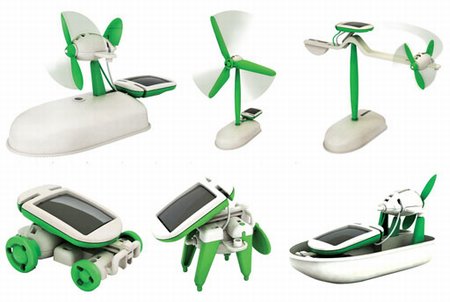
Solar Toy

What I want for Christmas: A 6-in-1 Solar Robot Kit. A pocket sized electric motor powered by a small solar panel allows you make any of the toys shown below: plane, car, boat, windmill or even a dog.


The toy can be motivated by a sunny day or a 50-watt halogen lamp. Enjoy.

Saturday, December 12, 2009

Solar Power from Outer Space


Not to be out done by Japan, California has a plan to harvest solar energy from orbit. California’s state legislators have approved a space-based solar project. The system is estimated to generate 1.7 terawatt-hours annually, once it comes online in 2016.

Power will be collected by solar panels on orbiting satellites. The energy will then be converted into radio waves and transmitted to a collection station in Fresno, California. From there it will join the electrical grid where it will power an estimated 250,000 homes.


By having the panels in space, the solar energy can be collected nearly 24 hours per day, and collection is unaffected by weather, seasons, or atmospheric filtering.

Via ecofriend

California's legislature must be assuming that all rooftops and sunny spots in the state will be covered by solar panels by 2015.

Thursday, December 10, 2009

Home Energy Makeover

Follow these four simple steps to cut your energy costs and make your home more comfortable in every season:

  1. Schedule a 3-4 hour assessment with a specially trained Home Performance with ENERGY STAR® contractor. Testing with state-of-the-art equipment pinpoints where your home is wasting energy.

  2. Receive a customized action plan that prioritizes cost-effective, energy-saving improvements needed in your home. You'll see what you pay now and what you could pay when your home runs at peak performance.

  3. Choose the improvements that fit your budget and use Energy Trust incentives and state and federal tax credits to help offset the cost.

  4. Enjoy lower energy costs, greater year-round comfort, better indoor air quality and enjoy the payback.
Saving energy saves more than money.

via The Energy Trust of Oregon

Sunday, December 6, 2009

Oregon Wave Project

Oregon is moving ahead with plans for the nation’s first commercial wave energy station.

On Friday morning, Ocean Power Technologies of New Jersey announced a deal with Oregon Iron Works to build a 10-buoy prototype system 2.5 miles off the coast of Reedsport, OR.

“We’re thrilled to be under way,” said Mark Draper, Ocean Power’s chief executive, in a telephone interview before the announcement. “We hope this is just the beginning of a new phase in capturing a major source of renewable energy.”

The first buoy will weigh about 200 tons and stand as tall as a three-story building, it is expected to deploy next year; with the remaining nine going in the water over the next two years. The full system price tag is $60 million and expected capacity is 1.5 megawatts, about half the peak of a single giant wind turbine. Wave energy, however, will be 24x7 consistent rather than intermittent like wind.

The project is being paid for by Ocean Power, Oregon tax breaks, federal funds, and PNGC Power coop, which has agreed to purchase the energy for its customers in Douglass County, Ore. It will create about 150 local jobs. If this prototype goes well, Ocean Power Tech expects to deploy a 200 buoy system nearby.

Wave-power is still a nascent technology, success is far from guaranteed. Two years ago a 40-ton wave-power buoy from Finavera Co sank off the Oregon coast after only two months of use. In California, state regulators last rejected a wave power project (also Finavera’s), saying that the technology was “pre-commercial” and that the “contract price is not reasonable.” The wave project that is furthest along, off the coast of Portugal, ran into financial difficulties earlier this year.

This Oregon project has also seen resistance from local fishermen. Nick Furman, executive director of the Oregon Dungeness Crab Commission, said his group is “not particularly excited about Ocean Power Technologies’s plans. But we’re keeping an open mind.” He added that while his members have accepted the presence of the initial buoys, they are very concerned about plans for the larger array, which “is too big a project in the wrong place at the wrong time.”

Mr. Draper of Ocean Power said his company has worked hard to make sure the buoys will withstand powerful storms and is trying to make sure no one’s livelihood is harmed.

If this project is successful, it could be the start of a cleaner powered future. If a method is found to harness oceanic energy, studies have shown that it alone could power the world's current demand twice over.

Via NY Times & EcoGeek

Oregon Wave Energy Back Story

Saturday, December 5, 2009

Celtic Solar


When I started this blog, I had no idea that there was a business in Launceston, Cornwall UK named Celtic Solar. This blog is not associated with the company at all, but as namesake spirits I thought it only appropriate to share a little about them with the video below.


If you are in the UK and looking for a better way to heat your swimming pool or hot water, give this a call.

Link:

Thursday, December 3, 2009

World's First Osmotic Power Prototype Plant Opens

dateline: Oslo, Norway


Statkraft this week opened the world's first osmotic prototype plant. The plant generates power by exploiting the energy available when fresh water and seawater are mixed.

"This new technology generates electricity simply by mixing water. New solutions to meet the climate challenges might be closer than we expect, which makes me confident that the future looks bright," said Bård Mikkelsen, Statkraft's CEO and president.

Statkraft said that it has been researching osmotic power since 1997 and has developed this prototype in cooperation with R&D organizations from many countries.

Energy is produced through the natural phenomenon of osmosis. Osmosis is the transport of water through a semi-permeable membrane. Where fresh water meets salt water, for instance where a river runs into the sea, enormous amounts of energy potential.

At the osmotic power plant, fresh water and salt water are guided into separate chambers, divided by an artificial membrane. The salt molecules in the sea water pulls the freshwater through the membrane, increasing the pressure on the sea water side. The pressure equals that of a a 120 meter water column. The pressure is used to turn a turbine.

The prototype will have a limited production capacity and is intended primarily for testing and development purposes. The aim is to be capable of constructing a commercial osmotic power plant within a few years.

Anywhere that rivers meet the ocean, this technology could be applied. The global potential of osmotic power is estimated to be 1,600-1,700 terrawatt-hours per year, which is equivalent to 50 percent of the EU's total power production.

Via Renewable Energy News

Tuesday, December 1, 2009

November PV and EV Report


November went out with a solar whimper as the final day of the month was foggy and generated a mere 1.2 kWh. Our panels generated 119 kWh for the month. This bested November 2008's result of 101 kWh.

I logged 465 miles in the electric vehicle, using an estimated 325 kWh.

This brings 2009's total energy generated to 3.7 MWh and EV energy used to 3.0 MWh.