On Mon, May 11, 2009, Stephen wrote:
> I'm looking for ways to reduce my power usage so I can eventually power 2
> EVs and my house (from my roof solar panels), rather than just 1 EV and the
> house. My Refrigerator is more than 20 years old, so I know that needs to
> be replaced in order to save energy.
Here are some electricity saving tips:

Use a front loading washer with high speed-spin cycle (1400 - 1600 RPM or higher). The high-speed spin will extract more water so the dryer does not have to work as hard. There are even stand-alone spinners that can do 3000+ RPMs! These are cheap and small and can supplement your current laundry appliances.
Use a clothesline or a laundry rack instead of a dryer. Line drying is easier/faster when the clothes are well spun.
Have your HVAC duct system checked and sealed. You could be dumping conditioned air into your attic and/or crawl space. In the US you can get a $250 incentive and in Oregon, you can get incentives up to $750 to help pay for this.
 Replace incandescent light bulbs with compact fluorescent or LEDs.
Turn off your computer when you are not using it. Sleep is not as good as Off.
 Use a Smart Strip Power Strip - These can automatically turn off your DVD player and game consoles when you turn off the TV. A second one can automatically turn off your monitor, printer, and speakers when you turn off the computer.
Replace that CRT monitor with an LCD display. If you still have a CRT, it is old and you deserve an upgrade.
For cooling, use fans. If you must have cooling and fans are not enough, consider a ground source heat pump rather than an air conditioner. If a central heat pump won't work for you, consider a "ductless, mini-split heat pump". These are standalone units that can be installed in any room with an exterior wall. You can install them in the room(s) that you use most to supplement your existing HVAC system. And they can be used to heat or cool.
For the S10EV, charge it when it is cool so the heat pump does not have to run. The inductive charging system already has losses (traded for safety); when the heat-pump runs, the S10EV is a Watt-hog.
 Get a Kill-a-watt meter and you can determine what is using too much power and make a plan to get rid of it, replace it, or put it on a smart strip. If you don't want to buy a Kill-a-watt, one cheap alternative is to feel the transformers that charge and power many devices (be careful not to burn yourself, some of them can get really hot). If the charger is warm, that is wasted energy and an inefficient device. High efficient transformers are cheap and can pay for themselves quickly. Look for a switching power supply transformer. These can scale their energy use to meet the demand, rather than supplying the max and wasting the overage. Make sure you get the correct Volt, Amp, Watt, and connector.
If you use electricity to heat your home, look into a Zoned System so you only heat/cool the room(s) you are in. Or you can use space heaters rather than the central heating system. Again, a heat pump (central or ductless mini) is a highly efficient heating and cooling system.
Ceiling fans can be used in the winter too. Most have a direction switch on them. In the winter, have them blowing up gently to circulate the hot air off of the ceiling.
 If you are buying a new TV, don't buy one that is bigger than the room needs. TVs have been getting lower power per square inch but the sizes are going up faster than the power savings. So the net is that TVs now use more energy than ever. If you want something over 50", look into a projector. These can use half the power of a similar sized screen. For a smaller then 50" screen, LED or OLED TVs are just starting to come out in earnest (you might have seen the recent Samsung humming bird commercial). These promise to be the most energy efficient yet (compared to LCD or plasma). So, if you can hold out for these to proliferate and come down in price, I would recommend waiting. Plus they are really thin.
When shopping for new appliances, look for the Energy Star logo. The lower energy use by these items means they save you money over the years so it may be worth spending more for a higher efficiency item. And you can often get incentives and tax credits to offset the higher initial cost.
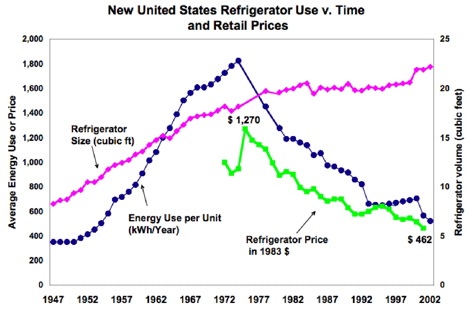
You mentioned a 20 year old refrigerator, it has got to go. If you have a refrigerator or freezer that was built before 2000, replace it. There have been great improvements in fridge-tech. If you have an older second fridge, get rid of it; shuffling the old fridge into the garage does not stop it from sucking down kWhs.
You mentioned a 20 year old refrigerator, it has got to go. If you have a refrigerator or freezer that was built before 2000, replace it. There have been great improvements in fridge-tech. If you have an older second fridge, get rid of it; shuffling the old fridge into the garage does not stop it from sucking down kWhs.
Use a front loading washer with high speed-spin cycle (1400 - 1600 RPM or higher). The high-speed spin will extract more water so the dryer does not have to work as hard. There are even stand-alone spinners that can do 3000+ RPMs! These are cheap and small and can supplement your current laundry appliances.
Use a clothesline or a laundry rack instead of a dryer. Line drying is easier/faster when the clothes are well spun.
Have your HVAC duct system checked and sealed. You could be dumping conditioned air into your attic and/or crawl space. In the US you can get a $250 incentive and in Oregon, you can get incentives up to $750 to help pay for this.
Replace incandescent light bulbs with compact fluorescent or LEDs.Turn off your computer when you are not using it. Sleep is not as good as Off.
Use a Smart Strip Power Strip - These can automatically turn off your DVD player and game consoles when you turn off the TV. A second one can automatically turn off your monitor, printer, and speakers when you turn off the computer.Replace that CRT monitor with an LCD display. If you still have a CRT, it is old and you deserve an upgrade.
For cooling, use fans. If you must have cooling and fans are not enough, consider a ground source heat pump rather than an air conditioner. If a central heat pump won't work for you, consider a "ductless, mini-split heat pump". These are standalone units that can be installed in any room with an exterior wall. You can install them in the room(s) that you use most to supplement your existing HVAC system. And they can be used to heat or cool.
For the S10EV, charge it when it is cool so the heat pump does not have to run. The inductive charging system already has losses (traded for safety); when the heat-pump runs, the S10EV is a Watt-hog.
Get a Kill-a-watt meter and you can determine what is using too much power and make a plan to get rid of it, replace it, or put it on a smart strip. If you don't want to buy a Kill-a-watt, one cheap alternative is to feel the transformers that charge and power many devices (be careful not to burn yourself, some of them can get really hot). If the charger is warm, that is wasted energy and an inefficient device. High efficient transformers are cheap and can pay for themselves quickly. Look for a switching power supply transformer. These can scale their energy use to meet the demand, rather than supplying the max and wasting the overage. Make sure you get the correct Volt, Amp, Watt, and connector.If you use electricity to heat your home, look into a Zoned System so you only heat/cool the room(s) you are in. Or you can use space heaters rather than the central heating system. Again, a heat pump (central or ductless mini) is a highly efficient heating and cooling system.
Ceiling fans can be used in the winter too. Most have a direction switch on them. In the winter, have them blowing up gently to circulate the hot air off of the ceiling.
 If you are buying a new TV, don't buy one that is bigger than the room needs. TVs have been getting lower power per square inch but the sizes are going up faster than the power savings. So the net is that TVs now use more energy than ever. If you want something over 50", look into a projector. These can use half the power of a similar sized screen. For a smaller then 50" screen, LED or OLED TVs are just starting to come out in earnest (you might have seen the recent Samsung humming bird commercial). These promise to be the most energy efficient yet (compared to LCD or plasma). So, if you can hold out for these to proliferate and come down in price, I would recommend waiting. Plus they are really thin.
I hope you find one or more of these tips helpful.
Saving electricity saves more than money.
If going without is not an option, go efficient.
If you have a PV system that only provides a portion of your electricity (like most grid tied systems), then reducing your home's electricity demand means that your PV system can provide a bigger percentage of your energy needs.
Links:
Learn ways to save energy and use renewable energy at home. Tips include appliances, remodeling, transportation, audits, hiring professionals, finding incentives and more.
The online, do-it-yourself home energy audit tool created by Lawrence Berkeley National Laboratory. The Home Energy Saver calculator helps you find ways to save energy, and find the resources to make the savings happen.
DSIRE is a comprehensive source of information on state, local, utility, and federal incentives and policies that promote renewable energy and energy efficiency.
Offers conservation & renewable incentives. Energy Trust also offers a free home energy review for Oregonians that are customers of PGE, Pacific Power, NW Natural or Cascade Natural Gas. We got a couple free CFLs and a free low flow shower head when they did our free audit.