Tuesday, December 28, 2010

2010 Review & 2011 Look Ahead

Since 2007 I have been driving an electric vehicle, powered by solar panels on the roof of my house. Each year I look at how much energy my driving used and how much the solar panels generated. I want my EV transportation to be better than net zero. So how did 2010 do? Let's take a look and then see what will change in 2011.

In 2010, the solar panels generated 3575 kWh. That is enough energy to drive my electric truck 5100 miles. I drove my EV only 4506 miles. This means the PV system generated 425 kWh more than my driving used; yet another year of free driving. 

Now that the first Chevy Volt and Nissan LEAF cars have been delivered, there is a lot of press about the coming wave of electric vehicles and how they could overwhelm the grid. Our "EV driving" home does just the opposite. We supply power to the grid during sunny days when the air conditioners are running and charge the EV overnight. We supply energy when it is most needed, and withdraw it when there is a surplus. This helps to stabilize the grid, not bring it crashing down.

Sure, not everyone that buys an EV will get solar, but once I was driving with electricity, the source of that electricity mattered more than it ever had when I flipped on a light switch. And unlike with gasoline, I had a choice to produce it myself. I hope this awakening experience is a common one in the next decade.

One final note about 2010 before we look to the future: Our PV system's 2010 production was below 2008 and 2009's output by ~6%. There are two reasons, first the system was offline for 31 days starting in late January when the house painters sprayed paint into the inverter exhaust vent and killed it. Our inverter manufacturer, SMA, was very cool about it and gave me a refurbished replacement unit for free even though this was clearly not their fault. The second reason for the reduced output was the predominantly cloudy weather in May and June of 2010 when compared to the previous two years. In short, 2010 had a cloudy, rainy spring.

Looking ahead to 2011, there is one big change planned. I have ordered a Nissan LEAF. In early December I was told the car should arrive in 4 to 7 months. This means I should get the car, my first brand new car ever, before my birthday in July. This car will change my EV energy consumption in two ways. First, my heavy non-aerodynamic induction-charged truck uses about 700 Wh per mile. The Nissan LEAF is rated to use 340 Wh per mile for 73 mile range by the EPA. With a little hypermiling, I think I'll be able to use only 250 Wh per mile for a 100 mile range. This means that I'll be using less than half the energy per mile in the LEAF than I am using today. On the flip-side, with the longer 100 mile range of the LEAF compared to the 35 mile range of my truck, I'll be able to drive the LEAF far more. It will be interesting to compare energy use of these two vehicles and how the longer range changes my driving habits.

Monday, December 20, 2010

Federal Solar Energy Plans Skip Oregon

Federal officials plan to accelerate large-scale solar energy developments across the Western United States. However, OPB News reports that those plans do not include Oregon.

Interior Secretary, Ken Salazar, named 24 public lands areas in six states to be prioritized for utility-scale solar projects. The lucky states are Arizona, California, Colorado, Nevada, New Mexico, and Utah. This list does not include the vast BLM lands in the sunny southeastern part of Oregon.

BLM officials said that Oregon was excluded because the lands have impediments such as inadequate transmission lines and a lack of nearby population centers.

Rachel Shimshak with Portland-based Renewable Northwest said the solar projects could still benefit Oregon, “Remember that in Oregon, we have a variety of solar manufacturers. So the kinds of jobs and manufacturing opportunity that Oregon has to serve projects in the Southwest is high.”

Federal officials are focusing the future of large-scale solar investment on "solar zones.” Oregon was passed over this time, but Oregon's solar advocates will continue to point out the benefits of solar investment in the state.

Via OPB News

Thursday, December 16, 2010

Nissan LEAF Was My Idea

Have you ever seen the commercials for Windows 7 where a user has an idea for an OS feature? In the ad, Windows 7 came out and it included that feature. The user then proclaims "Windows 7 was my idea." That is how I feel about the Nissan LEAF.

The first Nissan LEAF cars are being delivered to customers this week. This is a historic time for EVs. In October of 2008, I was selected to take part in a small focus group of EV-drivers with Nissan. We met with several people from Nissan including Mark Perry, director of product planning and strategy for electric vehicles. This was the first time that I had ever met anyone from Nissan. I had no idea if Nissan was serious about EVs, or if they would really listen to what I had to say. I had been reading a lot of press about EVs at that time and I had not seen a product that focused on what I thought were the right things. A chance to talk to a car company, any car company, was an opportunity to share my thoughts.

During the session, I was one of the last participants to address the Nissan team. Most of the other members talked to them about how great 100 miles would be and about deploying charging infrastructure. As I have discussed recently, I don't think charging infrastructure is the priority. Rather, I focused on what I thought the *car* should be. Obviously I am biased, but it seemed to me that the Nissan team was far more engaged when talking with me than with the other participants. They had several direct questions as well as open ended discussion areas. Here are some of the many things we talked about.

Set Realistic Expectations
Their opening statement was "We will be selling an affordable, mass market, 100-mile range, fully electric, freeway capable car. It comes to market in late 2010. What do you think the car needs in order to be successful and what do we as a company need to do to make it work in your region?"  I was skeptical. Remember this was 2008. It is easy to make big claims like this and no one had ever delivered on them. Every EV that had been brought to market up till that point had been a niche vehicle. Even the highly priced Tesla Roadster had slipped its delivery date multiple times in 2007 and in 2008 only a handful of Roadsters had been delivered. It was the only freeway capable EV being sold at that time, and with the $100k price tag it was a niche vehicle. With Tesla having CEO troubles, it was not clear if the little up-start would survive and ever make it to their "Blue Star" project. In 2008, wildly hyped vaporware was the norm in the EV world. I suggested that they take the opposite approach and "under commit and over deliver" rather than fall into the hype-cycle syndrome. If the vehicle was really only going to get 70 miles of range in real-world driving, start saying so now.

The rule of thumb is that an EV must exceed the 70/70 point to have any hope of broad appeal. That is minimum of 70 miles range in real world conditions and minimum of 70 MPH top speed. If the goal truly is a mass market vehicle, they must surpass these minimums, or go back to the drawing board.

Range Anxiety
Our next topic was range: One hundred miles of range was the stated goal. Many of the participants in the room talked about how great that was and how it is more than enough for most people, even if they don't know it. And while I agree with that, the important thing is to make sure the vehicle alleviates range concerns whenever possible. Make the vehicle to sell to the customers as they are; not how you want them to be. People currently are concerned with range. When I am showing my EV, the most common question is how "far will it go?". Right or wrong, some people will be concerned about range until EVs can drive the 300+ miles per charge, comparable to a typical full tank of gasoline.

To address range concerns, Nissan must give drivers the range data in a clear picture. My recommendations were:

  1. Show how far the current charge level will take the vehicle. Not with just a number, but I wanted to see on the map if the place I want to go is within my currently available range. I wanted to be able to check this even if I had not entered my destination, because most of the time I know where I am going and do not need to enter an address.
  2. Include charging station locations in the navigation system maps. This seems obvious now, you can find Google mash-up maps of just about anything, but back then (over 2 years ago) it seemed like a great idea.
  3. If I enter a destination beyond the range, suggest charging points along the way.
  4. Have a "Find Nearest Charging Station" button that is prominent. The button should be on the steering-wheel or a fixed button near the navigation system. I don't want to have to go through levels of menus to get to this. This is the "Oh no, low battery!" button.
Charging station locations will be added frequently over the first few years that the cars will be on the road. It is a pain to keep car navigation system maps up to date. You have to download files, burn a disc or use a thumb drive, take it to the car... Forget all that, it is a hassle and I would not want to do it on a frequent basis. Rather, I said they should include a telematics system that automatically updates the maps in near real-time.

Size
When they asked what size I thought the vehicle needed to be, I told them the story of buying our first hybrid. Early in 2000 our Subaru Outback had been totaled. We wanted a fuel efficient car to replace it. After some research we had found that Honda and Toyota were coming out with hybrids within the next year. These were the top two candidates. A few months later, a nearby Honda dealership had an Insight that we could test drive. It was not a good fit for us. The 2-door felt crowded and impractical. Based on that test drive, we went to Toyota and put down a deposit on the 4-door Prius, sight unseen, no test drive (there were no cars in our area to drive yet).

We were on a waiting list to get one of the first Prius sold in the US. It was 9 months before the car arrived. During which time my wife took the bus to and from work. She was determined to get a car that used less fuel and was already loyal to a car that she had never driven.

What does this anecdotal story mean to Nissan for their (then yet-to-be-named) electric vehicle? If they truly want it to be mass market, make it a 4-door. I also mentioned that the car should be sized for Americans; we are big people and generally need a little more room than people from other parts of the world.

Naming
Multiple participants asked in various ways what they were going to call the vehicle. They did not give us any hints. When the name topic came to me, my only suggestion was that they have a dedicated EV name. E.g., they should not launch with an "Electric Altima" or an "Electric Cube". My example was again the Prius. Prius sales were far better than Hybrid Camry or Hybrid Civic. If they wanted electric versions of their existing line, they could do this later. They must have an EV flagship product first.

For early adopters especially, part of the experience of buying a new breed of cars is being part of something special. This does not mean the vehicle has to stand out as weird, but it does have to be recognizably badged as an EV. It has to be its own brand and not "just a sub-brand". Owners will want a name they can rally around, with their own fan sites and discussion groups. They don't want to be some sub-group on a gasoline car forum. 

Ford's hybrid badge uses a leaf
Later after the name LEAF was announced I found out why they did not give us any hint at what the name might be. They wanted a single worldwide name for the vehicle and Nissan's various countries could not agree, primarily Japan and the USA offices could not agree. Japan would suggest something like "the Nissan Plug" and the USA office would point out how that name has no excitement and would be subject to ridicule. Other names ran into copyright issues in one or more countries.

Toyota's Prius marketing used a leaf
The name LEAF even had some trouble. First Nissan could not get the rights to use a leaf symbol. Check out their early marketing. They use a blue tree. Whereas both Ford and Toyota use a leaf symbol (see pictures to the right). The name LEAF is an acronym (or more likely a bacronym) of Leading, Environmentally-friendly, Affordable, Family car. The use of the name as an acronym likely cleared some final region's legal hurdle.

Gas Car Rental Partnership 
About one week before this meeting with Nissan, I was talking to another member of the Oregon EV Association about what he drives and I was surprised to hear that his only car was an EV, whereas in my household the EV was just one of three vehicles. When I asked what he does when he needed to drive farther than his EV would take him, he said he was a member of Zip Car and that there was a car that parked in a dedicated spot at his work and several cars were within EV range of his house. He could take the Zip car whenever he needed it. I found this model of EV ownership and ride sharing interesting.

I suggested that Nissan should consider a partnership with ride-share companies and car rental companies to give Nissan EV owners discounts on occasional gas car use. 

Roadside Assistance
Soon before attending this meeting with Nissan, I received an email from AAA of Oregon stating that they were adding roadside assistance for bicyclists. If you get a flat or bend a fork, you could call AAA and get repair help or a ride back home for you and your bike.

If AAA were willing to add bike assistance, what could they do for EVs? If you were to run out of battery power, could they bring a 240V generator to you and give you enough of a charge to get home or to the nearest charging station? It is unlikely that this service would be needed often, but the point of a roadside assistance program is peace of mind. Also, if this further alleviates range anxiety, it would be a good idea to work with road side assistance companies to support EV drivers.  

Under The Hood
As I have mentioned before, I show my EV a few times each year at various events. People often want to see under the hood. In a conversion EV there are usually interesting things to see, like where parts were mounted and how various wires were run. My EV, however, was factory build as electric by GM. It has a large heat-sink that covers most of the visible area under the hood. Frankly, it is boring. Yet, people are curious and so the hood is up and it leaves them underwhelmed.

I told them that early Nissan EV owners are going to be advocates for these cars. People will approach them and ask questions, and based on my experience they will want to see under the hood. So Nissan should consider adding a little more visual appeal here than they normally would.

LEDs
I have written in this blog several times about LEDs. A couple months before this meeting, I changed the tail lights in my EV to LEDs because they illuminate faster and they are brighter. If a vehicle were designed for LEDs, they could also use less power. I suggested that the Nissan EV use LEDs wherever they could.

Regen Breaking Level
Most people that are into alt cars love regenerative braking, so much so that they want to feel it kicking in as soon as they lift their foot off of the accelerator. I prefer to coast when I can. Coasting maintains momentum and if the obstruction ahead clears or the light turns green, you can keep on going rather than stopping and starting. Even if you have great regenerative breaking, coasting is better than regening and then accelerating again.

My recommendation to Nissan was to keep the regen light until the brake pedal is actually touched. This makes it much easier to hypermile coast and extend the range.

Solar Panel
My final item to them was to mention that they should consider adding a solar panel, but perhaps not for the reason that you think. Yes, I am a solar advocate, but I am an engineer first. If you want a solar powered EV, currently the best way to do that is with solar panels on your house, not on a car. There simply is not enough roof space on a car to make it practical today.

So if I know the math does not support it, why did I suggest that they have an option for a solar panel? Nearly every time that I am displaying my EV at an eco-event, someone will suggest that it would be great if I could add solar panels. I used to explain the available surface area and angle and efficiency details, often during this explanation their eyes would glaze over. Now I just say "Well, I have solar on my house. It works better there since I never park my house in the shade."

Nissan could avoid a deluge of email in their inbox from well intentioned, uninformed people by adding a solar panel; even if it is just a single small panel that is only offered as an over-priced accessory. It does not need to add any range it just needs a token function such as running a cooling fan. This gesture would make them happy.

Again, this is about selling to the customer that is there, not some ideal person. And explaining to someone that they have a bad idea is generally not the best way to start a customer relationship.

Conclusions
After the meeting, as we are leaving and shaking hands with the Nissan team, saying thanks and goodbye, Mark Perry from Nissan takes me aside. He said something like, "I really liked what you had to say today and I have made some notes to take back to the engineering teams". I am sure that many of the things that define the LEAF today would be exactly the same as they are even if I had not attended this meeting. And I am sure they don't make any decisions based on input from one guy in a customer roundtable session. But once the LEAF did come out, and I saw that it had many of the things that I had suggested, it felt good. It felt like they really listened and that I helped make this generation of EVs a little better.

To this day when I see a review of the LEAF and someone says "I really like this nav system. It shows me exactly how far I can go with this circle and it shows me all the charging stations around here.", I think "That was my idea. I'm glad you like it."

Comparing the LEAF to my suggestions
So how did Nissan do with the LEAF compared to what I thought an EV should be? Some of that is covered already, but I'll do a point by point breakdown in another blog post soon.


-----------------
C-Net Review of the LEAF

Wednesday, December 15, 2010

EV Infrastructure: What Kind and How Much

In the recent Chicken-and-Egg posting about EV charging infrastructure, I claimed that a vast charging infrastructure is not required for EVs to be highly useful for a large number of people. If you have a dedicated outlet where the car is parked overnight, you don't need a charging station at the bank, movie theater, or coffee shop. Having them is nice, but not a requirement.

Public charging stations should be used as a convenience, not as a requirement.
While I assert that they are not 'required', that does not mean that they aren't nice to have. A PEV driver is far more likely to stop at a place that allows them to plug in than at a neighboring competitor that does not have a plug. And once stopped, that driver may stay longer knowing that their batteries are getting juiced up. That could mean buying another coffee, soda, or whatever wares that the shop sells. Businesses that want to court plug-in vehicle drivers will install charging equipment.
Level 2 Public Charging Station in Portland
In addition to these businesses, some local governments will be installing charging stations too. What criteria will be used to determine where these charging stations will be installed and what type will they be? In many cases, that will be up to local policy-makers. Do they have the right information to make these decisions? 

Just as journalists have incorrectly claimed there was a chicken-and-egg problem, some policy-makers are setting out to solve this problem with millions of dollars being spent on public charging infrastructure. My last posting accused journalists of having little more than a few test drives as the sum total of their EV driving experience. For these policy-makers, their EV experience is likely less. In fact, it may consist only of reading articles by these under-informed journalists. Pike Research reported that more than 5 million charge points (nearly $6.5 billion in revenue) will be installed worldwide by 2015. ECOtality said it would install more than 1,100 Blink charging stations in the Portland, Salem, Eugene, and Corvallis areas, making Oregon a major hub in the company's $230 million plan. The US Federal government plans to install more than 15,000 charging stations across six states over the next three years. I hope this money is spent in the right way.


Consider this: A policy-maker with no EV experience receives some of the above grant money and wants EVs to succeed in his/her region. They are tasked with making an "EV success plan". They don't know where to start or what the challenges will be, so they begin to research and read press articles. The vast majority of articles state that EVs cannot be successful without a charging infrastructure. A-ha! Now they have a problem they can solve. They read on and are told that level 1 charging is too slow. After some research they determine that DC fast chargers are too expensive to be densely deployed. So they make a plan to blanket the region with level 2 charging stations and EVs will take over.

Now the plan framework is complete, it still needs details. Unfortunately, this is the wrong plan. A plan that consists only of blanketing a region with public charging stations, misses many important issues. EVs have had a couple false starts already (1910s, 1990s). Poor planning and bad policies could kill them a 3rd time. It is important that local governments are focused on the right things.

What are the right policies? Cars spend most of their time parked at home. This is where they are most likely to be recharged. So this is where the emphasis should be for charging infrastructure deployment. During this period of infrastructure growth, for every EV that is sold in a region, there should be about 1.2 charging stations installed. That would be one charging station installed where the car will be parked overnight and the other fraction to support a shared public charging station. For example, if 500 PEVs are sold in a region, then there would be 500 home charging stations and 100 public charging stations installed in that area.
A regional EV success plan is more than blanketing a region with charging stations.
Charging stations are just part of the picture. Here are the things that I think policy-makers should be considering.
  1. New home codes to support EVs: 
  2. SAE J1772 Connector - Supports Level 1 and Level 2
    • Require pre-wiring for charging stations. A two car garage should be wired to support two charging stations. Home electrical service panel, a.k.a. circuit breaker boxes, should have pre-dedicated circuits for charging stations.
    • Sufficient Home Amperage. That same two car garage should be able to support the load of two EVs charging (while the AC, dryer, and water heater are running, while the plasma screen TV, game consoles and computers are on and a hair dryer is running). Modern homes demand a lot from our energy grid.  
    • Apartments and Condos: 
      • Accommodations for high-density living areas must be made too. Require charging facilities in all new apartment building and condo complex parking areas. Charging facilities where cars are parked overnight is what is important. EVs cannot only be for people that own homes.
      • Create incentives for retrofitting existing apartments. These should be done in such a way that encourages pay-as-you go business models for charging. An apartment dweller is not going to pay $500 or more to have a charging station installed. They may, however, pay $40 extra per month for a dedicated parking spot that has a charging station. 
    • Hotels/Inns
      • Add charging stations where guests' rental cars are parked. This would allow EVs to be rented for local driving during vacations and business travel. Again this could be a premium upgrade parking space, or part of a partnership with the car rental company.
    • Usage Incentives 
      • Put policies in place to make your region EV friendly, such as:
        • HOV access
        • Dedicated parking city spots
        • Don't add "EV taxes": Some politicians are concerned that EVs don't buy gasoline; therefore owners do not pay fuel taxes which are used for road maintenance or upgrades. This concern is overblown. Any alternative road tax can be delayed until EVs are a meaningful number (say 5%) of vehicles on the road. Until then they can be taxed at the same rate as bicyclists and pedestrians that use the road, zero %.  
    • Broader Network of Cheaper Plugs
      Level 1 charging is the best solution for many cases.
      When considering public charging locations, it would generally be more effective to have a lot of level 1 (standard outlets), than to have a few level 2 stations, or a single DC fast charge station. I think level 1 charging is being dismissed, when it could be the best solution that we have. If you are installing a charging station in a long term parking area for example, that car is likely to be there for several days. It will be full when it is picked up, regardless of the charging level. This is one clear example, but there are several other use cases where level 1 would be preferred.  There are several advantages to having standard (level 1) outlets: 
      1. For the cost of a level 2 charging station, you can have far more level 1 outlets. If a location has only a few stations, then it is more likely that they would be occupied. Rather, if you have a parking lot that has 8 outlets on every lamp post, PEV drivers will easily be able to find a spot to plug in. 
      2. No monitoring needed. If there are only a few level 2 stations, then a potential user might want to be able to check the status of the stations online to see if they are operational and available. This means that the stations have to be managed. This further adds to the cost discrepancy between level 1 and level 2. Rather if there are as many outlets as there are parking spaces, availability is not a concern.  
      3. Lower energy cost. Level 1 plugs dispense energy at about one quarter of the rate of a level 2 station. If a business is installing a station only as a customer convenience, then there is no need to attempt to fill the vehicle up all the way during a short stop.
      4. Lower grid load. Since public charging stations are more likely to be used during the day than home (over night) charging stations, making them level 1 reduces peak-time grid load.
      5. Any electrician can install or repair them. Level 1 parts are simply the outdoor plugs that homes already have, they are cheap and available at your local home store if repair or replacements are needed. 
      6. They can be used for purposes other than EVs. Since level 1 is a standard outlet, these plugs can be useful for other things such as engine block heaters, holiday lights, and dead starter battery charging. Near outdoor seating areas they could be used for customers' computers... 

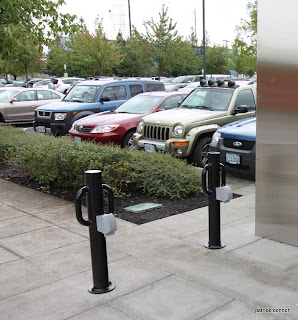
    Outdoor Level 1 Charging Outlets on Bike Lock Posts

    For EV infrastructure the initial focus for charging stations should be to get them to locations where cars will be parked overnight. The stations that I have seen installed so far in my local region have been in curbside parking and daytime use lots. These are not locations where cars are left overnight. These are nice for public visibility and ribbon cutting ceremonies, but they are not the locations needed for most effective utilization.

    Indoor Level 1 and NEMA 14-50 (level 2) Charging Station

    Here is an idea for an EV charging station company: team up with apartment complexes and install Visa swipe pay-as-you go charging stations. If the charging station company pays for the station and the installation, the apartment complex can pay for the electricity. The charging station company gets the revenue until the charging station is paid for, then they enter into a revenue sharing agreement.


    For full disclosure, I must mention that I was selected to receive a free level 2 charging station in my garage. This was from ECOtality and funded by a U.S. Department of Energy grant of $99.8 million. While I am making the case that level 1 is usually sufficient, I am not going to say 'no' to a free level 2 charging station. In return for the free station, data from my vehicle such as distances driven and charging habits will be collected for a national labs study. 

    Level 3 DC Fast Charge Station
    The U.S. Department of Transportation gave Oregon a $2 million TIGER II grant for Level 3 stations. The funds will provide up to two dozen DC fast charge stations in northwest Oregon. That is $83,000 per station. Two million dollars could install a lot of level 1 outlets rather than just 24 fast charging stations.

    The obvious counter point here is that there are areas where fast charging can be very useful. A drive from Portland to Hood River is 70 miles. So a round trip is beyond the capability of a 100 mile range EV. However, if Hood River had a DC fast charge station installed, then you could drive there and back on a day trip to wind surf in one of the world's best places to catch the wind.

    However, if you plan on driving an EV from Portland to Hood River, I would argue that you are attempting to force a square peg into a round hole. Trips like this are not what 100 mile range EVs are designed to do. Don't let that stop you though. If you are the adventurous type it might work out fine. However, be prepared to stay a few hours if the fast charge station is not available.
    Level 3 DC Fast Charge Connector

    I don't expect this one lone voice to be well heard against the mass of press. The message here is also not a simple one. If I had just said 'yes we need charging stations', I could find support. If I had said 'these are a waste of money', that message too could find a receptive (although different) audience. However, this message is neither of these extremes. Instead, it is about the efficient use of the planning resources and funds that we have available for infrastructure deployment.

    Monday, December 6, 2010

    EVs & Charging Infrastructure - Not Chickens & Eggs


    There has been a glut of electric vehicle (EV) press recently, some of it pro-EV, some anti-EV. One thing these articles seem to agree on is that EVs are not usable until a charging infrastructure is deployed. They call it by different names such as the chicken and egg problem, or catch 22, or infrastructure shortage problem but they generally agree that EVs cannot be successful until networks of charging stations are deployed.

    Despite the fact that these two sides agree, they are wrong! The vast majority of this press was written by people whose EV experience consists of a few test drives at best. I assume their reasoning is something like this: for gasoline powered cars there are gas stations and I see them everywhere. So, if I were to drive an electric car, I would need to see charging stations in equal or greater abundance. If you have driven gasoline-fueled cars for decades, it can be difficult to see that electric vehicles are more than just a change in the fuel source.

    An EV with 100 miles of range has more than enough driving distance for most people on most days. That means that you can charge your EV in your garage overnight with off-peak rates and there is no need to charge it at all during the day. You don't even need a special charging station in your garage. A simple outlet will do. If your car is plugged in for 10 hours, that will give you 60-70 miles of range. Most people drive less than 40 miles each day. The outlet you likely already have in your garage can charge an EV. 

    Public charging stations should be used as a convenience, not as a requirement.
    There are benefits to having charging stations around. They act as a safety net. Knowing they are there provides peace of mind to drivers that are new to EV technology. However, if you are buying an EV and your planned usage *depends* on the availability of public charging infrastructure to be successful, perhaps you should rethink the type of vehicle you plan to buy. Consider buying one with longer range or a plug-in hybrid instead. There will be times when a charging station is down, occupied, or otherwise not available due to construction or an event.

    There are a couple hundred EVs that are active in Oregon today. These vehicles were being used for commuting and errands and all the around-town things that people do in cars, long before there was an EV infrastructure to support them. Furthermore, most of these EVs that are on the road in 2010 are conversions or NEVs with less than 60 miles of range. This means that the new generation of OEM EVs, that have significantly more range, will be able to get along without a vast infrastructure roll-out too.

    There is no chicken and egg problem. The outlets that we need are already here now. It's the same one I use for my lawn mower and leaf blower. Adding level 2 charging stations in garages and adding public charging infrastructure makes EVs more convenient, but they are not preventing EVs from being ready for you to drive right now.
    ...

    If public charging stations are just a convenience or safety net, what does that mean for how and where they should be deployed? More on that aspect soon.