Showing posts with label PV. Show all posts

Tuesday, December 28, 2010

2010 Review & 2011 Look Ahead

Since 2007 I have been driving an electric vehicle, powered by solar panels on the roof of my house. Each year I look at how much energy my driving used and how much the solar panels generated. I want my EV transportation to be better than net zero. So how did 2010 do? Let's take a look and then see what will change in 2011.

In 2010, the solar panels generated 3575 kWh. That is enough energy to drive my electric truck 5100 miles. I drove my EV only 4506 miles. This means the PV system generated 425 kWh more than my driving used; yet another year of free driving. 

Now that the first Chevy Volt and Nissan LEAF cars have been delivered, there is a lot of press about the coming wave of electric vehicles and how they could overwhelm the grid. Our "EV driving" home does just the opposite. We supply power to the grid during sunny days when the air conditioners are running and charge the EV overnight. We supply energy when it is most needed, and withdraw it when there is a surplus. This helps to stabilize the grid, not bring it crashing down.

Sure, not everyone that buys an EV will get solar, but once I was driving with electricity, the source of that electricity mattered more than it ever had when I flipped on a light switch. And unlike with gasoline, I had a choice to produce it myself. I hope this awakening experience is a common one in the next decade.

One final note about 2010 before we look to the future: Our PV system's 2010 production was below 2008 and 2009's output by ~6%. There are two reasons, first the system was offline for 31 days starting in late January when the house painters sprayed paint into the inverter exhaust vent and killed it. Our inverter manufacturer, SMA, was very cool about it and gave me a refurbished replacement unit for free even though this was clearly not their fault. The second reason for the reduced output was the predominantly cloudy weather in May and June of 2010 when compared to the previous two years. In short, 2010 had a cloudy, rainy spring.

Looking ahead to 2011, there is one big change planned. I have ordered a Nissan LEAF. In early December I was told the car should arrive in 4 to 7 months. This means I should get the car, my first brand new car ever, before my birthday in July. This car will change my EV energy consumption in two ways. First, my heavy non-aerodynamic induction-charged truck uses about 700 Wh per mile. The Nissan LEAF is rated to use 340 Wh per mile for 73 mile range by the EPA. With a little hypermiling, I think I'll be able to use only 250 Wh per mile for a 100 mile range. This means that I'll be using less than half the energy per mile in the LEAF than I am using today. On the flip-side, with the longer 100 mile range of the LEAF compared to the 35 mile range of my truck, I'll be able to drive the LEAF far more. It will be interesting to compare energy use of these two vehicles and how the longer range changes my driving habits.

Monday, December 20, 2010

Federal Solar Energy Plans Skip Oregon

Federal officials plan to accelerate large-scale solar energy developments across the Western United States. However, OPB News reports that those plans do not include Oregon.

Interior Secretary, Ken Salazar, named 24 public lands areas in six states to be prioritized for utility-scale solar projects. The lucky states are Arizona, California, Colorado, Nevada, New Mexico, and Utah. This list does not include the vast BLM lands in the sunny southeastern part of Oregon.

BLM officials said that Oregon was excluded because the lands have impediments such as inadequate transmission lines and a lack of nearby population centers.

Rachel Shimshak with Portland-based Renewable Northwest said the solar projects could still benefit Oregon, “Remember that in Oregon, we have a variety of solar manufacturers. So the kinds of jobs and manufacturing opportunity that Oregon has to serve projects in the Southwest is high.”

Federal officials are focusing the future of large-scale solar investment on "solar zones.” Oregon was passed over this time, but Oregon's solar advocates will continue to point out the benefits of solar investment in the state.

Via OPB News

Wednesday, June 2, 2010

May 2010 PV & EV Report

Tesla Roadster Test Drive in Portland May 2010
The Seattle sales office of Tesla took a little road-trip down to Portland and I was lucky enough to get to drive a Roadster. The picture above is of my friend Jim as he pulled out on the start of his test drive. See that big smile? That is known as the EV-grin. Driving an electric vehicle is a blast, driving a sports car is a blast, putting the two together and you are sure to smile.

Excluding the Tesla drive, I logged 446 miles of EV driving this month, using an estimated 320kWh. During the same time our PV system had its best month this year and produced 475kWh of energy. Driving on sunshine is an easy thing to do.

Wednesday, May 12, 2010

Solar 101 Video

Here is a quick video that answers the following questions:

  • How is sunlight turned into electricity?
  • What are the basic components of a solar electric (photovoltaic)?
  • What is the grid?
  • What happens to surplus electricity?
  • What does an "inverter" do?
  • Can my meter run backwards?


Thursday, April 1, 2010

March 2010 EV and PV Report


Spring is here and the solar panels are starting to produce the juice. In March, our little PV system generated 294 kWh. That is enough to run a CFL for nearly 200,000 hours. Since its late 2007 installation, our system has generated a total of 8.1 megawatt-hours. We passed the 8MWh milestone on March 21st, the 2nd day of Spring here in the northern hemisphere.

For my EV driving, I logged 472 miles in the Chevy S10 EV, using an estimated 300kWh. This is nearly equivalent to what the panels produced. This means that, as it continues to get sunnier and the days get longer throughout the summer, we'll be generating more power than the EV driving uses.

The big new in electric vehicle for March is that Nissan announced the price of the LEAF. It is $32,780. However, there is a $7500 federal tax credit bringing the price to 25,280. And additional state incentives are offered in California, Colorado, Georgia, Illinois, Louisiana, Oklahoma, Oregon, South Carolina, & Utah. In my state of Oregon the incentive is $1500, bringing the price to $23,780. In California, the state incentive is $5000 making this 100 mile range EV only $20,280. That is cheaper than a Prius and far cheaper to "fill up".

Monday, March 1, 2010

February 2010 EV & PV Report

Each month, I have been reporting how much solar energy our solar photovoltaic system has made and how much energy I have used driving my electric vehicle.

In late January, our inverted died. It is still under warranty, but because it had paint on it from when our house was painted, we were not able to cross-ship a replacement. Rather, the painted inverter had to be shipped to the manufacturer, repaired and then shipped back. Technically, the paint voided the warranty but the manufacturer was still willing to honor the warranty as long as we were willing to keep the painted case. That is good customer service.

The repairs were not quick and a shipping mix-up delayed the return even longer. Our inverter was not back in operation until Feb 26th. That is 38 days that we were offline, so there is very little PV energy generation to report. But I am glad this happened in February instead of the more productive June-August months.

As for EV driving, I logged 345 miles in the Chevy S10 EV, using an estimated 242 kWhs.

Saturday, February 27, 2010

Zero Net Energy Home

Modern, no sacrifice, living area with no heating or electricity costs.

Monday, February 1, 2010

Inverter Down


As the January report indicated, our PV inverter died on Jan 19. The error code was "MSD-IDIF". After talking to SMA support about it, I was informed that this is a chipset error on the AC side. The April 2009 error of "Disturbance FAC-BRC" was also on the AC side. Also both of these failures happened soon after a brief blackout. This may not be relevant but it is suspicious.

They asked me several questions about my home:
1) What size is the service main?
2) Is the inverter on the bottom of the breaker box as recommended?
3) What gauge of wire connects the inverter? (8G, 6G...)
4) What size breaker is the inverter on? (40A 2 pull or something else)

I'll get these answers and let you know if any of them turn out to be relevant.

January 2010 EV and PV Report


January's big news is that our inverter has died. This is the second one that had gone belly up since we had our system installed in November 2007. When I called the installer, they asked what brand and model it was and they were surprised to hear that it was an SMA since they don't often have to replace the SMA inverters.

To complicate things, they were not able to fix it here onsite and they were not able cross-ship a replacement. We had our home painted last year and part of the inverter was accidentally painted. This means that our painted inverter must be shipped to SMA, be repaired, and then shipped back to us. The inverter died on the 19th and was taken away on the 25th and it is still not back.

With this month's limited up time, the system only generated 35kWh. This is significantly less than Jan 2009's 123kWh. When the inverter is returned, perhaps I'll try to remove the paint so we can cross-ship it, if this ever happens again. I am glad that it has a 5 year warranty and I hope this is the last problem that we have.

As for electric vehicle (EV) driving, I logged 326 miles using an estimated 228kWh. With the cold weather and the 11 year old batteries, they started to "complain" (battery life light) near the end of my 20 mile commute even though I had more than 50% charge left. So during the coldest week, I drove the Honda rather than the Chevy S10 Electric. This also gave me 4WD which I needed on one of the snowy days.

Next month I'll report the reinstall of our inverter.

Friday, January 29, 2010

Solar Powered Water in Portland

Portland Water Bureau Goes Solar


The Portland Water Bureau is putting in a 267kW solar installation near the Portland Airport (PDX). This is the second installation for the Water Bureau and comes with a $2.2M price tag.

The location is challenging because this  solar power plant is located in a field with high groundwater. “The water table is right at the surface,” said EC Company Renewable Solutions Manager, Robin Rabiroff, “We had to take into account the drainage and settling of the site.”

To enable the Water Bureau to track energy production of the site, the four commercial inverters, made by Bend Oregon company PV Powered, are outfitted with performance monitoring systems from DECK Monitoring of Eugene, Oregon. The monitoring website has been linked to the Bureau’s website for easy access by ratepayers.

“We’ve been using PV Powered commercial inverters for more than a year on various projects,” said EC’s Rabiroff “Their product quality is top notch, ... Plus, we like dealing with an Oregon-based company.”

“We also like teaming up with local companies to deliver leading-edge renewable energy solutions in Oregon,” said Erick Petersen, VP of Sales and Marketing at PV Powered. “For our part, PV Powered ensures that our customers get maximum energy harvest...”

Among the other commercial projects that EC Company has installed with PV Powered commercial inverters is the 107kW rooftop plant that was recently put in at the Portland Community College.

Related Link

Wednesday, January 6, 2010

Mobile Solar, Power Where You Need It


Solis Energy has launched a new solar-powered charger that can run small 12V electronics in remote locations or in places where grid electricity isn’t available. Dubbed "Power HotSpot", the device can power a range of electronic devices that run on 12V DC input.

The company claims that the multipurpose device can be used to recharge cellphones, notebooks or provide power to inverters for AC power. The $375 device is also useful for recreational purposes that include providing power to campsites and recharging lights and iPods.

Via: ecofriend

Friday, January 1, 2010

2009 PV & EV Report

2009 Solar Power and Electric Driving in Review


2010 is here. 2009 is now in the books. Each month we look at how our photovoltaic (PV) system performed and how much the electric vehicle (EV) used. Let's review 2009.

We have a small PV system on our home in Oregon. My primary commuter vehicle is an electric Chevy S10 truck. On an annual basis, the PV system makes more energy than the EV uses. Which means, I drive for free, cost free, & pollution free.

In 2009, the PV system generated 3799 kWh. Of these, 917 were fed back into the grid and 'banked' for our use later. 2009 set one record for our system. June 28th generated 25.54 kWh, this eked past the previous record of 25.52 held by June 15th 2008.

As for driving, in 2009 I logged 4909 miles in the EV. This used an estimated 3400 kWh.


So the PV system generated ~400 more kWh than the EV used. And the bulk of the energy were made during the summer and so helped to alleviate the stress caused when the air conditioners were on high. Whereas the EV was charged overnight when the grid was not stressed and the winds were blowing through the Columbia gorge, turning the many turbines there.

Here is looking forward to a great 2010. Solar lease programs are now available in many states, so you can get a PV system of your own for little or no start-up cost. And 2010 could be the year that affordable, mass market EVs hit the showroom. So you too can drive on free fuel.


Sunday, December 20, 2009

Earth and Sun and Moon


I recently read a story about research to use Helium-3 from the Moon for fusion power. Helium-3 is a non-radioactive element that is rare on Earth. However, it is abundant on the Moon. If we ever wanted to use it to generate energy, this has, among other things, the obvious complication of moving the helium-3 (or the energy) from the Moon the Earth. This is just research and not going to be a cure to our energy issues anytime soon, if ever. But it did provoke an interesting thought.


Would this be the first lunar source of power that we could harness? No. At least to a small degree, we collect lunar power today with wave and tidal power. And furthermore, helium-3 is caused by the solar winds interacting with the lunar surface, so it is actually an embodied form of solar power.

Drat, what I thought was the first Moon power source was neither the first, nor from the moon.

What are the original sources of all of the energy that we use today? I propose that they all originate from one of three sources: The Earth, the Sun, or the Moon.

We have already covered wave and tidal energy from the Moon's pull on our oceans.

Geothermal and hot springs are an energy sourced from the Earth's fiery core. Some chemical energy could be Earth sourced too. More on that below.

Fossil Fuels are biological matter that were trapped and converted by bacterial processes, heat and pressure. This is true for crude, coal, and natural gas (methane). The majority of the biological matter would have been fed from the food chain and so is originally sourced from the Sun with Earth processing for the heat and pressure.

From the Sun more directly we derive photo-voltaic and solar thermal energy. Other sun sources include plant matter including biomass and plant, animal, & algae oils and even a simple campfire.

Hydro power harnesses the water cycle, this is primarily driven by water evaporated by the Sun.

Lightning: This is an interesting one. It is not harnessed, but you can't deny that it is powerful. Lightning is caused by weather, therefor this is a result of the Sun.

Chemical energy could be either Sun or Earth sourced. It depends on how the chemicals were created. Volcanic sulfur would be an example of an Earth source that could be used to generate energy. And we have already discussed hydrocarbons.

What other energy sources can you come up with? Are they Earth, Sun, or Moon or other? Until we start mining asteroids or other planets, we're stuck with just these three original sources. Let's make the best of them.

Thursday, December 17, 2009

Sun Dial Office Building


The world’s largest solar-powered building has been unveiled in China. The 75,000-square-meter office building design is based on a sun dial. It is located in Dezhou, in the Shangdong Province of northwest China.


Dubbed the Sun and the Moon Altar micro-row buildings, the architecture features the Chinese characters for sun and moon, while the white exterior symbolizes clean energy. The sustainable building provides space for exhibitions, scientific research, meeting facilities and a hotel.


In addition to a massive solar array, green ideas have been applied throughout the construction process. The external structure used only 1% steel for the Bird’s nest. The advanced insulation means energy use is 30% lower than a similar sized building. The 4th annual World Solar City Congress will be held here.


Via: ecofriend

Monday, December 14, 2009

Solar Toy

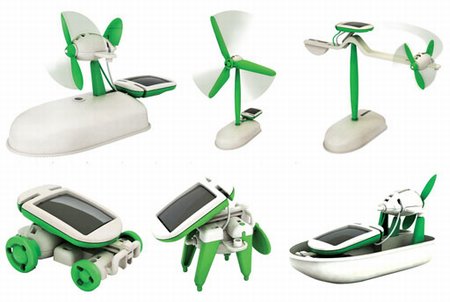
What I want for Christmas: A 6-in-1 Solar Robot Kit. A pocket sized electric motor powered by a small solar panel allows you make any of the toys shown below: plane, car, boat, windmill or even a dog.


The toy can be motivated by a sunny day or a 50-watt halogen lamp. Enjoy.

Saturday, December 12, 2009

Solar Power from Outer Space


Not to be out done by Japan, California has a plan to harvest solar energy from orbit. California’s state legislators have approved a space-based solar project. The system is estimated to generate 1.7 terawatt-hours annually, once it comes online in 2016.

Power will be collected by solar panels on orbiting satellites. The energy will then be converted into radio waves and transmitted to a collection station in Fresno, California. From there it will join the electrical grid where it will power an estimated 250,000 homes.


By having the panels in space, the solar energy can be collected nearly 24 hours per day, and collection is unaffected by weather, seasons, or atmospheric filtering.

Via ecofriend

California's legislature must be assuming that all rooftops and sunny spots in the state will be covered by solar panels by 2015.

Tuesday, December 1, 2009

November PV and EV Report


November went out with a solar whimper as the final day of the month was foggy and generated a mere 1.2 kWh. Our panels generated 119 kWh for the month. This bested November 2008's result of 101 kWh.

I logged 465 miles in the electric vehicle, using an estimated 325 kWh.

This brings 2009's total energy generated to 3.7 MWh and EV energy used to 3.0 MWh.

Friday, November 20, 2009

First Solar-Powered Flight Around the World


Above is a prototype of the solar powered plane known as the Impulse. It is the result of six years of work by a team of 70. Bertrand Piccard has already made history by flying around-the-world non-stop on a balloon flight. Now he plans on making history again by circling the world in the Impulse.


At 63 meters, the Impulse has the wingspan of a Boeing 747-400 and, at 3500lbs, the weight of an average family car. Over 12,000 solar cells supply the four 10 HP electric motors. This is roughly the same amount of power the Wright brothers had in 1903. During the day 90 lbs of lithium-polymer batteries are charged to allow flight throughout the night.

The first long range test flights are planned for later this year at Dübendorf airport followed by night flights over Switzerland in 2010. Based on the results of these test flights, the final version of the aircraft will be built to circumnavigating the world in 2012.

Links:

Sunday, October 18, 2009

Gorgeous Solar PV System


We have posted stories about solar tiles here before.

Solar has two big obstacles to overcome: cost and aesthetics. Integrated solar shingles helps overcome both of these. Building the solar into the building in the first place, rather than retro-fitting it, saves money and it can be financed with the house. Solar shingles also use thin-film PV, this is cheaper than silicon wafer PV. Thin-film is less efficient so you'll need to cover more of your roof.

As for the aesthetics, that is a very subjective topic. I find everything from roof mounted systems to solar troughs to be an elegant and beautiful technology. But many home-owners associations do not agree with me; however, solar shingles are allowed in many areas where roof mounted systems are not.

SRS Energy has developed roofing tiles that mimic Tuscan terracotta roofing tiles but contain amorphous silicon solar cells produced by Uni-Solar.

Via CNet


Links:

Tuesday, October 13, 2009

Solar Oregon Photo Contest

Each year Solar Oregon holds a photo contest. Below are the three runners up and the winning photo.

Christopher Morgan


Sam Doak


Gregory Flick


photo by Michele Renee, Contest Winner