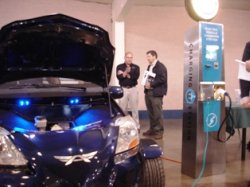
In the recent Chicken-and-Egg posting about EV charging infrastructure, I claimed that a vast charging infrastructure is not required for EVs to be highly useful for a large number of people. If you have a dedicated outlet where the car is parked overnight, you don't need a charging station at the bank, movie theater, or coffee shop. Having them is nice, but not a requirement.
| “ | Public charging stations should be used as a convenience, not as a requirement. |
While I assert that they are not 'required', that does not mean that they aren't nice to have. A PEV driver is far more likely to stop at a place that allows them to plug in than at a neighboring competitor that does not have a plug. And once stopped, that driver may stay longer knowing that their batteries are getting juiced up. That could mean buying another coffee, soda, or whatever wares that the shop sells. Businesses that want to court plug-in vehicle drivers will install charging equipment.
 |
| Level 2 Public Charging Station in Portland |
In addition to these businesses, some local governments will be installing charging stations too. What criteria will be used to determine where these charging stations will be installed and what type will they be? In many cases, that will be up to local policy-makers. Do they have the right information to make these decisions?
Just as journalists have incorrectly claimed there was a chicken-and-egg problem, some policy-makers are setting out to solve this problem with millions of dollars being spent on public charging infrastructure. My last posting accused journalists of having little more than a few test drives as the sum total of their EV driving experience. For these policy-makers, their EV experience is likely less. In fact, it may consist only of reading articles by these under-informed journalists. Pike Research reported that more than 5 million charge points (nearly $6.5 billion in revenue) will be installed worldwide by 2015. ECOtality said it would install more than 1,100 Blink charging stations in the Portland, Salem, Eugene, and Corvallis areas, making Oregon a major hub in the company's $230 million plan. The US Federal government plans to install more than 15,000 charging stations across six states over the next three years. I hope this money is spent in the right way.

Consider this: A policy-maker with no EV experience receives some of the above grant money and wants EVs to succeed in his/her region. They are tasked with making an "EV success plan". They don't know where to start or what the challenges will be, so they begin to research and read press articles. The vast majority of articles state that EVs cannot be successful without a charging infrastructure. A-ha! Now they have a problem they can solve. They read on and are told that level 1 charging is too slow. After some research they determine that DC fast chargers are too expensive to be densely deployed. So they make a plan to blanket the region with level 2 charging stations and EVs will take over.
Now the plan framework is complete, it still needs details. Unfortunately, this is the wrong plan. A plan that consists only of blanketing a region with public charging stations, misses many important issues. EVs have had a couple false starts already (1910s, 1990s). Poor planning and bad policies could kill them a 3rd time. It is important that local governments are focused on the right things.

What are the right policies? Cars spend most of their time parked at home. This is where they are most likely to be recharged. So this is where the emphasis should be for charging infrastructure deployment. During this period of infrastructure growth, for every EV that is sold in a region, there should be about 1.2 charging stations installed. That would be one charging station installed where the car will be parked overnight and the other fraction to support a shared public charging station. For example, if 500 PEVs are sold in a region, then there would be 500 home charging stations and 100 public charging stations installed in that area.
|
| “ | A regional EV success plan is more than blanketing a region with charging stations. |
Charging stations are just part of the picture. Here are the things that I think policy-makers should be considering.
- New home codes to support EVs:
 |
| SAE J1772 Connector - Supports Level 1 and Level 2 |
- Require pre-wiring for charging stations. A two car garage should be wired to support two charging stations. Home electrical service panel, a.k.a. circuit breaker boxes, should have pre-dedicated circuits for charging stations.
- Sufficient Home Amperage. That same two car garage should be able to support the load of two EVs charging (while the AC, dryer, and water heater are running, while the plasma screen TV, game consoles and computers are on and a hair dryer is running). Modern homes demand a lot from our energy grid.
- Apartments and Condos:
- Accommodations for high-density living areas must be made too. Require charging facilities in all new apartment building and condo complex parking areas. Charging facilities where cars are parked overnight is what is important. EVs cannot only be for people that own homes.
- Create incentives for retrofitting existing apartments. These should be done in such a way that encourages pay-as-you go business models for charging. An apartment dweller is not going to pay $500 or more to have a charging station installed. They may, however, pay $40 extra per month for a dedicated parking spot that has a charging station.
- Hotels/Inns
- Add charging stations where guests' rental cars are parked. This would allow EVs to be rented for local driving during vacations and business travel. Again this could be a premium upgrade parking space, or part of a partnership with the car rental company.
- Usage Incentives
- Put policies in place to make your region EV friendly, such as:
- HOV access
- Dedicated parking city spots
- Don't add "EV taxes": Some politicians are concerned that EVs don't buy gasoline; therefore owners do not pay fuel taxes which are used for road maintenance or upgrades. This concern is overblown. Any alternative road tax can be delayed until EVs are a meaningful number (say 5%) of vehicles on the road. Until then they can be taxed at the same rate as bicyclists and pedestrians that use the road, zero %.
- Broader Network of Cheaper Plugs
|
| “ | Level 1 charging is the best solution for many cases. |
When considering public charging locations, it would generally be more effective to have a lot of level 1 (standard outlets), than to have a few level 2 stations, or a single DC fast charge station. I think level 1 charging is being dismissed, when it could be the best solution that we have. If you are installing a charging station in a long term parking area for example, that car is likely to be there for several days. It will be full when it is picked up, regardless of the charging level. This is one clear example, but there are several other use cases where level 1 would be preferred. There are several advantages to having standard (level 1) outlets:
- For the cost of a level 2 charging station, you can have far more level 1 outlets. If a location has only a few stations, then it is more likely that they would be occupied. Rather, if you have a parking lot that has 8 outlets on every lamp post, PEV drivers will easily be able to find a spot to plug in.
- No monitoring needed. If there are only a few level 2 stations, then a potential user might want to be able to check the status of the stations online to see if they are operational and available. This means that the stations have to be managed. This further adds to the cost discrepancy between level 1 and level 2. Rather if there are as many outlets as there are parking spaces, availability is not a concern.
- Lower energy cost. Level 1 plugs dispense energy at about one quarter of the rate of a level 2 station. If a business is installing a station only as a customer convenience, then there is no need to attempt to fill the vehicle up all the way during a short stop.
- Lower grid load. Since public charging stations are more likely to be used during the day than home (over night) charging stations, making them level 1 reduces peak-time grid load.
- Any electrician can install or repair them. Level 1 parts are simply the outdoor plugs that homes already have, they are cheap and available at your local home store if repair or replacements are needed.
- They can be used for purposes other than EVs. Since level 1 is a standard outlet, these plugs can be useful for other things such as engine block heaters, holiday lights, and dead starter battery charging. Near outdoor seating areas they could be used for customers' computers...
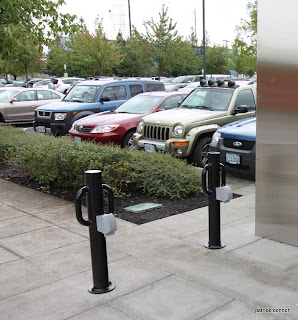 |
| Outdoor Level 1 Charging Outlets on Bike Lock Posts |
For EV infrastructure the initial focus for charging stations should be to get them to locations where cars will be parked overnight. The stations that I have seen installed so far in my local region have been in curbside parking and daytime use lots. These are not locations where cars are left overnight. These are nice for public visibility and ribbon cutting ceremonies, but they are not the locations needed for most effective utilization.
 |
| Indoor Level 1 and NEMA 14-50 (level 2) Charging Station |
Here is an idea for an EV charging station company: team up with apartment complexes and install Visa swipe pay-as-you go charging stations. If the charging station company pays for the station and the installation, the apartment complex can pay for the electricity. The charging station company gets the revenue until the charging station is paid for, then they enter into a revenue sharing agreement.
For full disclosure, I must mention that I was selected to receive a free level 2 charging station in my garage. This was from ECOtality and funded by a U.S. Department of Energy grant of $99.8 million. While I am making the case that level 1 is usually sufficient, I am not going to say 'no' to a free level 2 charging station. In return for the free station, data from my vehicle such as distances driven and charging habits will be collected for a national labs study.
 |
| Level 3 DC Fast Charge Station |
The U.S. Department of Transportation gave Oregon a $2 million TIGER II grant for Level 3 stations. The funds will provide up to two dozen DC fast charge stations in northwest Oregon. That is $83,000 per station. Two million dollars could install a lot of level 1 outlets rather than just 24 fast charging stations.
The obvious counter point here is that there are areas where fast charging can be very useful. A drive from Portland to Hood River is 70 miles. So a round trip is beyond the capability of a 100 mile range EV. However, if Hood River had a DC fast charge station installed, then you could drive there and back on a day trip to wind surf in one of the world's best places to catch the wind.
However, if you plan on driving an EV from Portland to Hood River, I would argue that you are attempting to force a square peg into a round hole. Trips like this are not what 100 mile range EVs are designed to do. Don't let that stop you though. If you are the adventurous type it might work out fine. However, be prepared to stay a few hours if the fast charge station is not available.
 |
| Level 3 DC Fast Charge Connector |
I don't expect this one lone voice to be well heard against the mass of press. The message here is also not a simple one. If I had just said 'yes we need charging stations', I could find support. If I had said 'these are a waste of money', that message too could find a receptive (although different) audience. However, this message is neither of these extremes. Instead, it is about the efficient use of the planning resources and funds that we have available for infrastructure deployment.


 The company is Farrell & Associates Inc. They are a real estate and property management company. They hope to attract eco-friendly customers with their new solar array and plug-in car charging station.
 The charging station has both level 1 and Level 2 charging and is open to the public free of charge!