Saturday, March 28, 2009

Solar Powered Plug-in Car Charging Station

As the banner at the top of our blog page says, "PV + EV = Drivin' on Sunshine". That is Photovoltaic (PV) and Electric Vehicles (EV) are a great combination. We love plug-in cars and solar power here at CelticSolar. Above is a picture of a charging station that helps bring these two technologies together. It generates solar power and you can plug-in your electric ride. It is called the NRGSpot.


With only a small solar area on top of the charger, it is not going to be generating significant (if any) power from sunlight for charging so it is connected to the grid too. If you have the room for it, a solar covered car port is a much better option to maximize the solar collection area. However, in a spot like a downtown street where these are intended, something is better than nothing, even if the solar only covers the device's human interface operations like the solar powered parking meters in downtown Portland.


If there is a sunny spot that has a little more room, then the RubeStation (shown below) might be the answer. From RubeLab and Advanced Solar Photonics the array serves as a sunshade or rain shelter as well as a clean power source.

Thursday, March 26, 2009

America’s Biggest Solar Plant Just Got Bigger


Five month ago, in Hillsboro Oregon, SolarWorld held the grand opening of North America’s largest solar fab. On March 19th SolarWorld announced that N. America's largest solar plant was about to get bigger, they will add a new adjacent facility. 

The new building will measure about 210,000 square feet and increase the site’s plant space by 44 percent. The existing building -- formerly a semiconductor factory built but never put into full production -- measures about 480,000 square feet.

Via Press Release

Monday, March 23, 2009

LED Auto Lights

Shortly after I got my electric truck, I decided to put in LED brake lights and taillights. My thought was that they would use less power and (although minuscule) improve my range. This was not the case; however, LEDs turned out the be the right idea for a different reason.

I picked up the LEDs at a local auto parts store. They fit, they turned on; everything looked correct until I hit the turn signal. It blinked at an annoyingly fast pace. After some searching online I found out that the LEDs have a different (lower) impedance than the traditional bulbs. The difference in impedance made the flasher unit in my truck think the bulb was shorted. And because of the lower resistance, these were actually using more power.

I lamented my findings to an EV mailing list. The replies were helpful, others had similar issues and there were solutions. Furthermore, the real reason to retro fit with LEDs was not power, but the speed with which they turn on. LEDs light up about a fifth to a third of a second quicker than standard incandescent light bulbs. That may not sound like much, but at 65 MPH, a vehicle covers 19 feet in a fifth of a second. This could be the difference between a severe crash and a fender bender or the guy behind you stopping just in time and you avoiding the dreaded call to your insurance agent. You can actually see the difference in the time that it takes for LEDs vs old bulbs to come on in this EvNut video.

Reignited, I found there were 3 possible solutions to the quick flashing issue.
  1. Get LEDs with "legacy impedance"
  2. Get a new LED-ready flasher unit
  3. Install a resister in series with the LEDs
Trying these in the above order, I looked for legacy impedance LEDs that fit my truck. I found a company had made them at one point but they were bought and that line was discontinued. Moving down the list, I had no luck finding an LED ready flasher unit. I was able to find them for other Chevy's but not a 1998 S-10.

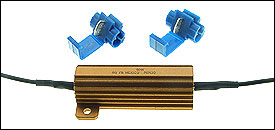
That left me with just option 3. I was thinking that I was going to have to get a multi-meter and make a trip to RadioShack. Luckily the product I needed already existed, complete with frame mountable heat-sink packaging.

After installing this 6 Ohm, 50 W resistor, the blink rate returned to normal. And despite my occasionally slow hypermiling driving, I have not been rear-ended.

LEDs cost more, but they last a lot longer and if they prevent an accident, it is money well spent.

LEDtronics Products > Automotive

enjoy

Saturday, March 21, 2009

"Grid-Connected Mobility" conference

Plug In America is sponsoring the "Grid-Connected Mobility" conference. 
May 27th -29th in San Francisco

It is intended to help accelerate the emerging "Smart Garage" industry. Investors, entrepreneurs, policy makers, car companies large and small, utilities, analysts and demand response aggregators will convene to map out and deploy the electric mobility industry of tomorrow. This event will provide unique insight into the best investments, and offer a robust setting for growing relationships and making deals. More details will be provided in April and www.pluginamerica.org.

Via PIA newsletter

Friday, March 20, 2009

Charge Up Portland


Portland Oregon Mayor Sam Adams is holding the first meeting for “Charge Up Portland” today. This project plans to install 500 plug-in car charging stations in and around Portland.

The greater Portland area already has a handful of free charging stations from the pilot program.

Wednesday, March 18, 2009

Solar Powered Tesla

Tesla delivered their 250th Roadster last Saturday. Lucky No. 250 was Dr. Rob Wilder of Encinitas CA. This roadster will be powered from his home's array of solar PV panels (shown above). As you can see below, he picked "very orange" as the exterior color to symbolize his car's connection with the sun.


Before getting his car, in his Tesla.com blog Dr. Wilder said, "Imagine: free fuel from the sun plus energy independence and a car faster than my brother’s 2008 Porsche Cayman S … wow." He no longer has to imagine, he has exactly that. 

After receiving his EV he said, "This car is an elegant solution to some of the world's most difficult problems. And buying it is helping push along EV adoption generally because Tesla is investing the money in lower-priced cars down the line."

Speaking of Tesla's lower priced cars, they will unveil the Model S sedan prototype on March 26th. Model S production is planned for late 2011. The Model S will have an anticipated base price of $57,400. After a federal tax credit of $7,500, the effective price will be $49,900; priced firmly in the luxury category. 


Tesla's ~$30,000 Bluestar remains simply a future plan. I hope they survive (and thrive) long enough to get it to production.

Via Tesla Newsletter

Tuesday, March 17, 2009

When The Spark Is Gone


Getting rid of your old electronics the green way. 


Earth911 helps you find a local place you can toss your old stuff to keep it out of the landfill. Electronics often have lead and other toxins, so it's a good idea to dispose of them correctly. Some of the drop off spots are libraries and county buildings.

The Ecycles programs of Oregon and Washington state, accept old TVs & computers for free.

Links: 
E-waste recycling

Saturday, March 14, 2009

Earth Hour, It is Easy

video
There are a lot of things you can do to help our planet; Earth Hour is one of the easy ones. 


While you are turning things off, you might also want to consider unplugging stuff that you don't use often (like that old VCR), they can create phantom loads.

links:


Friday, March 13, 2009

Grand Canyon Goes Green

An 18 kilowatt PV system has been installed at the Grand Canyon visitors center.


The 84 panels are on the roof and grounds around the center. 

It provides about 30% of the electricity needs and a chance to educate the public about solar. The Grand Canyon attracts 4.5 million people each year. 

“Visitors to Arizona’s most recognizable feature, the Grand Canyon, will now have the opportunity to enjoy the state's second most recognizable feature, sunshine,” said Barbara Lockwood, Renewable Energy Manager at Arizona Public Service. “The value of this system goes beyond the economic savings realized at the center. It is an educational tool as well as a way to increase Arizona’s visibility as a leader in solar energy.”

The center is planing a solar energy education exhibit with real-time monitoring of the amount of energy the system is producing.

Tuesday, March 10, 2009

Tanks But No Tanks Pt2

Our Tankless water heater is now installed. Here are the before and after pictures.

Before: Old Tank Water Heater
Before: The empty spot on the garage exterior wall where
the new water heater will be installed. That is the EV
charger on the right side of the picture and the solar
monitor (web-box) near the center.
After: The old tank was removed
and the new water filter is installed.
Here is the new Tankless Water Heater


To help pay for this gas saving unit, there are:

Federal Tax Incentive — $750 (30% up to $1500)
Oregon Residential Energy Tax Credit — $340 (from this chart)
Energy Trust of Oregon Incentives Tankless Type — $200 (Here)

If you know of any other incentives or rebates, please let me know.

That is a total of $1290 in incentives, which pays over half of our costs. Now we will never run out of hot water again and save gas.

As you can see in the after pictures, I still have some drywall work to do and the web-box needs to be remounted.

Monday, March 9, 2009

Tanks But No Tanks

High Efficiency Water Heating Compared

Having hot water at the simple turn of a tap is a great convenience. How your water is heated makes a difference. An efficient water heating system saves you money and reduces pollution. Water heating is about 15 percent of an average home’s energy use. An efficient system can cut that energy usage in half or better.


Our home came with a conventional natural gas, tank water heater. It recently went on the fritz. This is our opportunity to upgrade it. So what type of water heater to use? 

Of course given the name of this blog, the first consideration was solar hot water heating. More on that later. First, let's look at the options. Below is a chart of efficient water heaters from energyStar.gov.

High Efficiency Tank: These are conventional water heaters with highly insulated tanks. These are great for retrofits and not much more expensive than a traditional tank, but not that big of an energy savings compared to the other options. The drawback to this type is the energy used to keep the water hot at all times, known as “standby losses.”

On-Demand aka Tankless: These have been popular in Europe for years and are only now starting to have a significant presence in the US market. These heat the water when it is needed and so avoid the standby losses. There is no tank. Heat it when you need it; that is eloquent. And you have the benefit of "never running out" of hot water. Gas models do require a larger gas line than a tank water heater, so retrofitting may be difficult. You can buy these at various flow rates. Be sure you get a unit that can keep up with your household's needs.

Heat Pump aka Hybrid: These are relatively new to the market. Heat is extracted from ambient air and transferred into the water. When the air is too cold, then the "hybrid" models switch over to electric water heating mode. GE has a model planned for 2010, but I was unable to find any major brands that produce these today. If you must heat with electricity, this is your most efficient option. 

Solar Water Heating: This type costs the most up front, but they often don't need fuel and can "pay you back". The Sun’s energy is harnessed to reduce operating costs up to 90 percent. Since the Sun is not always out, solar water heating systems require a secondary water heater as a backup. Solar water heaters have their own tank. They either send the water itself up to be heated or another medium can be used and then the heat is transferred from this medium to the water. The advantage of a medium is that it can be something that does not freeze in the winter. Whereas water based systems must have a drain mechanism to make sure no water is left where it can freeze and burst a pipe.

So now we know something about each type. The first place I called was my solar installer, they install hot water systems too. They came out and looked at our setup. As it says above, solar hot water heating requires a tank of its own. So I would replace the tank system that we have now with a high efficiency tank and then add solar as a preheating system. This doesn't work for our little garage since we don't have room for two tanks. There is also an option for a single tank, this is electric when the solar cannot get the water to temp. The problem with this one is that our water heater is jammed in-between our furnace and a staircase. This single tank system was too big for the 23-inch space that we have. Unfortunately, it looks like solar water heating will not (yet) work in this house. 

The next most efficient system on the list is tankless. We had two contractors come out and give us quotes for a tankless system. The prices were outrageously different. The first one was in-line with what I expected. The second one was twice as much, wow. 

I checked out the CCB # of the cheaper quote and the brand of tankless that he recommended. It all looked good, so we are going tankless.

The tankless unit is going to be placed on the inside of the exterior wall so the new gas line can easily be run to it. This is what both contractors recommended. It means, however, that the water lines are going to be run across the ceiling of the garage. Too bad our house was not just built for tankless in the first place. 

The good news about the tankless unit being placed on another wall is that now we will have room for a solar tank if we want to add solar in the future. However, now that our water heating bill should be down to about $8 per month, I think other green projects will be higher on the priority list. Like adding more panels to the PV system.

We are taking this opportunity to install a whole-house water filter too. We had our water tested at a local lab to see that type of filter to get. Our water checked out great so we are getting a simple chlorine filter. 

When the system is installed, I'll post before and after pictures and discuss the High Efficiency Water Heating Incentives that I found. 

Links:
Energy Star Hot Water Guide

Sunday, March 8, 2009

Solar at German American School of Portland

The German American School of Portland has installed a 7.8 kilowatt PV system. It is made up of  45 modules. On March 6th they held a reception & celebration.

The installation is one of the biggest at an Oregon school, according to school officials. The system is expected to generate 7.8 megawatt-hours of electricity annually.

The project was made possible by modules donated by SolarWorld of Hillsboro and financial sponsors Portland General Electric and the Energy Trust of Oregon.

Wednesday, March 4, 2009

GreenStreet Solar Lending


Umpqua Bank & The Energy Trust of Oregon have teamed up to offer low-interest loans for energy-saving improvements and solar energy systems. The program is called GreenStreet Lending. It is for small businesses and homeowners to help you invest in efficiency and renewable energy.

Sunday, March 1, 2009

February 2009 Solar & EV Report

February is a nice milestone in Oregon Solar Power production. The days are getting longer and it shows in the results. We had two days (the 18th and 20th) over 10kWh. The last time that we had a day that productive was October 18th.


With a few days of light snow this month, Feb 2009 is a little behind snow free Feb 2008.

Feb'08 generated 184kWh.
Feb'09 generated 167kWh.

As for my electric vehicle driving, I logged 408 miles in the Chevy S10 Electric. This used an estimated 286 kWh.

As expected this time of year, our EV energy use has exceeded the solar panels ability to produce. We will make up this deficit, and more, in July and August when the grid needs the power most.

Around here, hydro-power is abundant this time of year. And heating is generally done by natural gas. So the electricity grid is not stressed as it is in the summer when the air conditioners are running.

Cheers.