Wednesday, July 29, 2009

Battery Swap


One of the limitations of electric vehicles today is the recharge time. There are several ways to solve this problem. Just like you would do with a battery powered toy, one of the solutions is battery swapping. You pull into a swap-station and faster than you could fill a combustion car with gas, your vehicle has a fresh, fully charged battery pack and you can head on down the road.


Better Place is an EV charging start up active in Israel, Denmark, Australia, Canada, California and Hawaii. Better Place founder and CEO Shai Agassi, said they have installed their first battery swap station in Yokohama Japan. Agassi said the stations will look a lot like a car wash. The “pancake style” battery pack is located under the vehicle, out of crash zones and does not interfere with passenger or storage spaces. Keeping the pack underneath also gives the vehicle a low center of gravity. Better Place has developed a “patented latching mechanism” to swap the battery pack.

Here is a video of how the swap system works.


At first, I did not like the idea of battery swapping. As an EV driver, I take measures to not abuse my batteries. The idea that I could get a pack that has been abused concerned me. If they are not 'your' batteries, some people are more likely to treat them like a rental car.

After meeting with Better Place, they alleviated these concerns and pointed out other benefits of swapping in addition to the quick fill-up. One, the packets all undergo diagnostics after they are extracted. Only packs that pass muster are charged up for future use. Failing packs are set aside for maintenance or replacement. Two, batteries are currently a rapidly evolving technology. As new innovations are brought to market, they can be put into new swap packs and you get more range. If you buy a car with a fixed pack, you won't get these upgrades unless you buy a new battery pack or car.

Tesla has said that battery swapping has been a subject of much "deep thinking." Unfortunately, Tesla has no plans to invest in a battery-swap system as part of the Model S' plan.

In another video below, you can see how battery swapping could fit into a day of EV driving with overnight charging at home for commuting, Level 2 charging at work and battery swapping for longer trips.

Monday, July 27, 2009

New Logo

After 300 posts, I thought it was time to have more than just a plain text logo. Above is the new Celtic Solar logo. Let me know what you think.

Saturday, July 25, 2009

Oregon Solar Feed-in Tariff


The Oregon House of Representatives has approved a bill to explore the possibility of introducing a solar-related feed-in tariff.

The Associated Press reports that House Bill 3039 creates a pilot program to study a feed-in tariff for solar projects under 500 kW. The The feed-in tariff would allow consumers to sell their solar-generated power to utilities at a wholesale rate set by the Public Utility Commission for a period of 15 years. After 15 years, the consumer would receive payments from the utility at market value.

If implemented, Oregon would join Vermont as the only states to introduce a feed-in tariff.

SOURCE: Associated Press


Wednesday, July 22, 2009

Renew America Roadtrip


If you had just gotten a new sports car, you might be tempted to take a summer roadtrip. The roadtrip is an American pastime favorite that captures the adventuresome pioneering spirit.


Now image that new sports car is a Tesla Roadster with ~250 miles of range and wicked fun acceleration. Suddenly, this roadtrip can be a chance to show the country that an electric car can be far more than mere golf carts, and what they can do for the environment.

With that goal, it has to be from coast-to-coast. And now that the event is growing, invite some friends, get sponsors, and make it mean something by raising money for charities along the way.

The Renew America Roadtrip was born; an all-electric drive across the country this summer for charity and the environment.

To raise awareness and raise money at each of the waypoints, the roadtrip will mobilizing a network of grass-roots volunteers to coordinate local crowd-pleasing events and draw local crowds and media.

The roadtrip is using viral videos, blogging, local and national press, YouTube, Twitter, and Facebook to help spread the word.

Events include nights out, rallies, and meet-ups at local clubs and venues, and specific events will feature environmentally-conscious musicians, celebrities, activists, and politicians as speakers.

Here are the upcoming stops:
7/22 – Iowa to Nebraska; Grinnell to Papillion
7/23 – Nebraska; Omaha to Gothenburg
7/24 – Colorado; Sterling to Denver
7/25 – Colorado; Denver to Colorado Springs
7/26 – Grand Canyon
7/27 – Nevada; Las Vegas
7/28 – Nevada to California; Vegas to Barstow
7/29 – California and celebration at Universal Studios

You can attend any of the events or volunteer. If you have an EV you could even join in for a leg of the drive. You can find more California locations and event details here:

Monday, July 20, 2009

40 Year Lunar Landing Anniversary

On July 20, 1969, the human race accomplished its (to date) greatest technological achievement when a human first set foot on another celestial body. Neil Armstrong took “One Small Step” into history.

The pictures of Earth from this and other Apollo missions sparked the modern environmental movement.


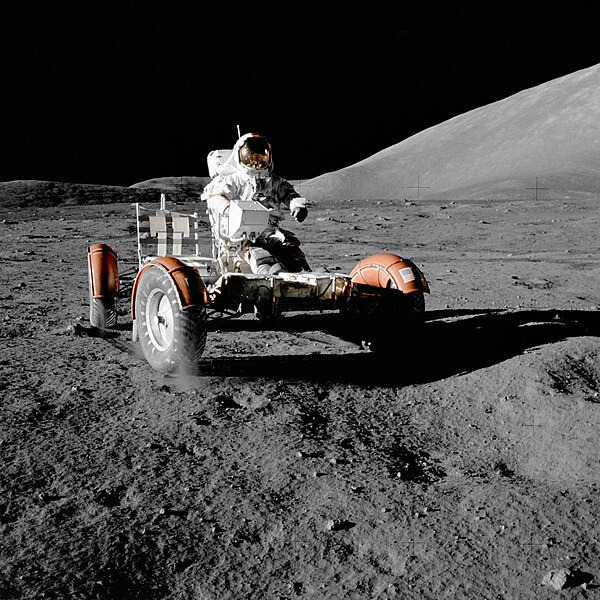
Two years and 11 days after that historic landing, another Apollo mission landed on the Moon. This time they brought something with them, a Lunar Rover. Previously the astronauts were restricted to the short distances they could walk in bulky space suits. Harrison Schmitt of Apollo 17 said, "...the Lunar Rover proved to be the reliable, safe and flexible lunar exploration vehicle we expected it to be. Without it, the major scientific discoveries of Apollo 15, 16, and 17 would not have been possible and our current understanding of lunar evolution would not have been possible."

Yes, it was a fantastic achievement, but what-on-earth does it have to do with this blog? The Lunar Rover was an EV. Each wheel had its own electric drive, a DC motor capable of 10,000 RPM. These were powered by two 36-volt silver-zinc potassium hydroxide non-rechargeable batteries.

Friday, July 17, 2009

Electric Avenue

Charging Stations Electrify the West Coast


Interstate 5 or, "The 5" as it is affectionately known by locals, is the major artery of the west coast. If you want to catch a ferry to Alaska, take The 5 to Bellingham WA. If you want to go to Disneyland, take The 5 to Anaheim. If you want to go to Washington, Oregon, or California by road from one of the same, you are most likely using I-5. The 1382 mile stretch runs from Tijuana to Vancouver BC passing through San Diego, L.A., Portland and Seattle just to name a few.

Earlier, we reported that I-5 was the first freeway in the US to be solar powered. This was possible in part because The 5 is federally designated as a "Corridor of the Future". This designation is also why I could post this blog entry with my WiMAX enabled notebook from the back seat of a car in northern Oregon as it zips along on I-5.

The solar-powered, Internet-enabled 5 is about to add another futurism to its list, Electric Vehicle charging stations. When the administration's green jobs stimulus money was made available, Oregon had already been running a pilot program to build and deploy charging stations in the state, making this a "shovel ready" program for Oregon.

One of the concerns often expressed is that charging for 30 minutes while you eat lunch or grocery shop is not going to fully charge the batteries. If you could get a free gallon of gas when you bought lunch, would you say "No, thanks. I need more than a gallon to fill-up my car." Of course not. So it is not a matter of filling up.

Being able to opportunistically charge, keeps the batteries from being deep cycled and makes them last longer. If you have a PHEV, it allows for more, potentially all, of that days travels to be electrically fueled. If you pull in to a rest stop on I-5 you are not likely to be there for very long. Say you use the facilities, get a coffee, eat a sandwich, and a half hour later, you are back on the road. How much of a charge could you get during this time? That depends what you plug it into.

The new standard for EV charging connectors is the J1772, defined by the Society of Automotive Engineers (SAE). It is being driven by companies like GM (in support of the Volt) and it can currently deliver two different levels of charging.

Level 1 is standard household outlet energy level (120V 15A)
Level 2 charging will be 240V at 12 Amps up to 80 Amps.
Some batteries are capable of taking a fast charge (480V 600A) and new breakthroughs are under development. This is level 3 charging and the standard is in the works. Since it is not available now, we'll leave it out of the discussion.

When a car is propelled by gasoline, it has a miles-per-gallon rating. Similarly, when it is propelled by electricity, it has a miles-per-kWh rating. Just, as with gas mileage, how you drive has a lot to with your actual results. The Chevy Volt and the Tesla Roadster have a similar electric performance of about 3 miles per kWh.

Given this, you can easily determine how fast the vehicle can charge. Level 1 charging is 120V @ 15A. That is 1.8 kWh per hour* or 5.4 miles per hour. This rate of charge would be good for overnight, but in our 30 minute stop, this is going too add less than 3 miles of electric range to a trip, not much help.

Level 2 charging, however, doubles the voltage and more than doubles the current, let see how far this could get you during a brief rest-stop. 240V @ 80A is 19.2 kWh per hour which translates to ~58 miles per hour of charge. In 30 minutes, that is about 29 miles worth of juice. The Volt has a 40 mile electric range, so during this brief stop, the batteries can be three quarters full. In a Volt, this means that you can pull in with empty batteries and running on gas and then leave running on electricity for the next 29 miles.

Let's do an example of an Oregon roadtrip in a PHEV-40 and see if charging stations along The 5 would make any difference.

Example from Portland to Eugene is 110 miles:
In a 50MPG car, this would use 2.2 gallons of gas.
In a PHEV-40 with 50MPG when depleted, this would use 12kWh of electrons and 1.4 gallons of gas. The PHEV saved some gas. Not bad, but we can do better.
Now add a 1 hour level 2 charging break in Salem. The trip now uses 24kWh of electrons and only 0.6 gallons of gas. It is tempting to say that 110 miles on 0.6 is getting 180 MPG, but that is hype-speak it ignores the electricity used. It is a slippery slope, be sure you are acknowledging that gasoline is only part of the energy mix used. You can say that stopping at the charging station cut the PHEV's gasoline usage by more than 50 percent (from 1.4 gallons to just 0.6 gallons). If the discussion is about how to get off dependence on petroleum, this is very relevant.

The PHEV with a charging break used less than 1/3rd of the gasoline of the 50MPG car (from 2.2 gallons to 0.6 gallons). And, of course, if this comparison was against a 25MPG vehicle, it would use about 1/7th of the gasoline. Clearly, charging stations can reduce gasoline use if they are placed conveniently such that drivers can "grab a few watts" whenever they stop for other reasons.

The 5 is a vital artery of west coast travel. A network of charging stations along The 5 can reduce gasoline use, reduce petroleum dependency, and reduce CO2 emissions. It is an important step in growing the infrastructure our nation needs for the coming generation of plug-in automobiles.

Links:

Wednesday, July 15, 2009

SolWest Renewable Energy Fair


July 24-26, 2009
John Day, Oregon

The eleventh annual SolWest Renewable Energy Fair will be held on July 24-26, 2009, at the Grant County Fairgrounds in John Day, OR. Admission includes over 50 free workshops on both off-grid and grid-tied renewable energy and sustainable living topics. In-depth pre-fair workshops will cover renewable energy technology and natural building. Fifty exhibitors show tools for energy independence and lifestyle self-reliance, including solar, wind and agricultural resources. Keynote speaker Jeff Mapes, author of “Pedaling Revolution,” will inspire you to view human-powered transportation as a healthy alternative.

Cost: $5 per adult per day, with weekend, youth, and family discounts

Website: SolWest Renewable Energy Fair 2009


Tuesday, July 14, 2009

U.S. installed solar capacity up 17 percent in 2008


Installed solar power capacity in the United States rose by 17 percent to 8,775 megawatts in 2008, the strongest growth in a single year, according to solar advocate Solar Energy Industries Association (SEIA) annual review.

It was the third straight year of record growth for the solar industry. It is widely expected that 2009 will be another record year. There are more than 6 gigawatts of concentrating solar power plants in the development pipeline, SEIA said.

Via Reuters

Saturday, July 11, 2009

62 Years to 100% Cheap and Clean "Blue" Energy


Bob Metcalfe is the inventor of Ethernet. He has watched the evolution of the Internet from its humble beginnings to the ubiquitous thing that it is now. What does he see as the next big thing the Internet will revolutionize? Energy!


Future Internet enabled smart grid(s) will be able to route energy from where it is being generated to where it is needed in milliseconds.

One of the interesting points of his talk, was that we should not have to conserve. What?!? All the green mantras are about sustainability and conservation. Yes, conservation is important today because most of the energy sources are brown sources. However, if we can get to a point where clean renewable power is cheap and abundant, there may be no need to conserve.

Hmmm... I would argue that I would rather see natural spaces rather than power plants, even if they were renewable power plants, but it is still thought provoking.


Mr. Metcalfe has a history of making predictions of major Internet outages that have not come to fruition. So as with all predictions, take them with a grain of salt. We have no way of knowing how the smallest things can grown exponentially and change the world.

Wednesday, July 8, 2009

EV Street Drags

What is faster in the quarter mile, an electric car or a muscle car?

Many people think "golf cart" when reading "electric car". So, the obvious answer is muscle car beats golf cart by a mile (well at least most of a quarter mile).

There are, however, vehicles that will challenge, wait make that destroy, the assumption that all electric vehicles (EVs) are golf carts. You have most likely heard of the Tesla Roadster, an awesome EV that has a 0-60 time of 3.9 seconds. A Roadster is more that enough to shatter the all-EVs are golf carts myth. There will be Tesla Roadsters there. And the Roadster will not be the fastest EV you can see at the Wayland Invitational.

Going green does not have to mean slow, dull, & boring! See that electric cars can be exciting, as well as environmentally responsible.

Battery Brats and Amp-Heads July 24 & 25, 2009 are the days you have been waiting for. See EVs leave "gasser" muscle cars in the dust. The Wayland Invitational IV electric drag racing EVent will be held at Portland International Raceway (PIR). Come see what electric power is all about as NEDRA (National Electric Drag Racing Association) hosts one of the hottest racing events.

This year's race has an additional special purpose. It will help to raise funds for a wonderful, bright young boy with autism. Curtis 'Junior' Cottengim needs a service dog to keep him calm and safe, but at $13,000 his family needs some help. Donations at the gate and local sponsorship can make this happen.

WHO WILL BE RACING

1) Bill Dube and the KillaCycle (0-60 in 2 seconds)
2) John Wayland and the infamous White Zombie Car (0-60 in 2.9 seconds)
3) Eva Hakansson's and her ElectroCat street bike
4) Mike Willmon and his Crazy Horse Pinto
5) Several Teslas
6) Rick Woodbury with Tango
7) Michael Kadie's awesome Cobra 2.S.S.I.C
8) Mike Schwartz's Green Tea Model T
9) Ken Koch and his fantastic '32 Ford
10) Otmar Ebenhoech's LiIon Insight
. . . . and more!


Wayland Invitational
July 24-25, 2009
Portland International Raceway
Portland, Oregon
Gates opens at 6:00 pm both Friday and Saturday
Charging available from available outlets
$8 adult admissions. Children 6 to 12 $5.00, 5 and under free.
$25 to race


Sunday, July 5, 2009

OEVA in Hillsboro 4th of July Parade 2009

The Oregon Electric Vehicle Association (OEVA) had six vehicles in the Hillsboro Oregon 2009 4th of July Parade (Pictures and two short videos below).

In starting order the OEVA vehicles were:
1) Corbin Sparrow
2) Honda Insight (converted to 100% electric)
3) Twike (2-seater electric with pedal assist)
4) Chevy S10 Electric (Factory made by GM as 100% electric in 1998)
5) Trike (custom made 3-wheeler chopper)
6) Zap Zebra PK Truck

The last two pictures in the slideset are other EVs that happened to be at the parade.


When the OEVA passed by the Rotary Club announcer's booth, we had a brief stop in the parade. This meant that we had a little more air-time. They talked briefly about our club, what we do, that electric cars might become big business for Oregon. Then they said to our Twike driver that the OEVA should hold an Electric Vehicle event right here in Oregon. Well guess what, we are doing exactly that on July 11th at Pioneer Courthouse Square starting at 9:30AM till 4:30PM. A great plug for our EVent.

1360 AM was also covering the parade. By the time I had seen their tent and turned on the radio, they were talking about the Girl Scouts that were behind us and wondering why 2 of them were wearing chicken suits. They could not figure it out and neither can I.

Enjoy the Pictures!

Saturday, July 4, 2009

Patriotic Environmentalist, not an Oxymoron

Happy 4th of July!
Environmental living can be patriotic.


Maintaining a natural and beautiful country, where people can live healthy and free, is patriotic.

GM has said (here) they are concerned that if they tout the environmental benefits of the Chevy Volt, then it will be rejected by the "NASCAR" crowd. On the flip-side, if they position it as a pro-American vehicle, they are concerned that it will upset the eco-crowd. To be successful, GM is going to need both groups to embrace this car. They need to portray the car as sexy and green.

"There is a fear that if we position this as a 'pro-American' car, it will upset some of the environmentally conscious crowd" explained Pete Lewis, program operations at GM. "And we want it to be embraced by everyone."

Things that are not antipodes are too often portrayed as such. Conflict and opposition is generally thought to be a more compelling story. We need to look beyond the simple "this or that" thinking that grabs headlines. Let's reapply the conjunction-junction and see that many more things can be "this and that". Rather than looking for divides and wedging them, let's look for and embrace commonalities.

Both Joe-six-pack and Jane-tree-hugger have errands to run and lives to lead. Neither want to fund terrorism or oppressive regimes. Both want affordable transportation and clean air to breathe.

Riding your bike to work rather than driving a pollution emitting car propelled by a fuel that funds terrorists, is both environmentally friendly and patriotic.

Understandably, GM's goal is to sell cars rather than change the way people think about the world, but maybe they can do a little of both.

Using less energy saves the reserves, allowing time to develop smooth transition plans. And allows the renewable sources currently on-line to provide a greater percentage of our supply.

Renewable energy is used in proximity to where it is generated. With a plug-in car, you can drive on locally generated electrons rather than imported fuel.

This will help stabilize costs. An uprising or disaster half-way around the world is not going to disrupt your locally generated energy supply.

Real Patriots Live Green - Happy 4th of July!

Links:

Wednesday, July 1, 2009

June 2009 EV & PV Report

On June 21st, here in the NW corner of Oregon, the Sunrise was at 5:21AM and Sunset was at 21:03. That is 15 hours 42 minutes of sunlight. Our west-facing PV solar system started generating power at 7:45AM and did so until 20:45. That is 13 hours of powering our home and feeding the grid.


For the month of June, we generated 509kWh, despite the first 3 weeks of the month being consistently cloudy.

Our best performing day this month was the 28th with 25.5kWh.

For EV driving, I logged 371 Miles using an estimated 260kWh.

Our PV system generated nearly twice as much energy as I used for driving.

Driving on Sunshine, Good Times!