Saturday, February 28, 2009



Federal Dollars for Alternative Energy
 Undeterred by the fact that ethanol is the worst type or alternative energy, the federal government is in love with corn ethanol, perhaps a bit too much. Over the years, the American farm lobby has worked and worked to get subsidies for corn growers and, more recently, ethanol producers. The result, as calculated the Environmental Working Group in a new report, is that ethanol (including made-from-corn biofuel) now receives more than three times as many federal dollars ($3 billion in 2007) than solar, wind, geothermal and other biomass combined. With ethanol, especially corn ethanol, losing its luster, the imbalance of the pie chart above will hopefully get the Obama administration and the new Congress to reevaluate how renewable energy resources are spent in the coming years. Cellulosic ethanol, algea fuels, solar and wind power all deserve a bigger slice, don't you think?
Friday, February 27, 2009
Save Hot Water


Thursday, February 26, 2009
500 Megawatts More Solar Power in California

Wednesday, February 25, 2009
Tuesday, February 24, 2009
Costs of Solar Going Down in U.S.
 A new study on the installed costs of solar photovoltaic (PV) power systems in the U.S. shows that the average cost of these systems declined significantly from 1998 to 2007, but remained relatively flat during the last two years of this period.
Researchers at the Department of Energy’s Lawrence Berkeley National Laboratory (Berkeley Lab) say that the overall decline in the installed cost of solar PV systems is mostly the result of decreases in nonmodule costs, such as the cost of labor, marketing, overhead, inverters, and the balance of systems.
“This suggests that state and local PV deployment programs — which likely have a greater impact on nonmodule costs than on module prices — have been at least somewhat successful in spurring cost reductions,” states the report, which was written by Ryan Wiser, Galen Barbose, and Carla Peterman of Berkeley Lab’s Environmental Energy Technologies Division.
Installations of solar PV systems have grown at a rapid rate in the U.S., and governments have offered various incentives to expand the solar market.
“A goal of government incentive programs is to help drive the cost of PV systems lower. One purpose of this study is to provide reliable information about the costs of installed systems over time,” says Wiser.
The study examined 37,000 grid-connected PV systems installed between 1998 and 2007 in 12 states. It found that average installed costs, in terms of real 2007 dollars per installed watt, declined from $10.50 per watt in 1998 to $7.60 per watt in 2007, equivalent to an average annual reduction of 30 cents per watt or 3.5 percent per year in real dollars.
Monday, February 23, 2009
Better Living

Earth friendly products for you, your home and garden. From cutting edge technologies and eco-chic fashion to better energy efficiency and sustainable outdoor living...The show is March 27 - 29 at the Portland Expo Center and has free admission.
Smart Garage Innovation Forum
A revolution in the way citizens use energy
How can Portland be a pioneer in the next generation of energy supply and usage…in electricity, transportation and lifestyle? A smart utility grid powered by renewable energy and electric vehicles are on the horizon, and together they could transform how we use energy, while creating business opportunities and jobs. Getting ready and reaping the full benefits requires coordinated action across many sectors, including utilities, automakers, government, local businesses and the community. We will connect, learn and create alignment within the Portland community to welcome the next generation of energy technologies.
More Info
Thursday, February 19, 2009
How Much Would You Pay For An EV?
Electric Vehicles have been announced by nearly every major auto manufacturer. Most of them are smaller 4-door cars. If you buy an EV, you'll save money on gas and maintenance and you'll spend a little more on electricity.
Wednesday, February 18, 2009
Congress Steps into the Light
 From VoteSolar.org
Click here to read about the solar provisions in the bill. The recovery package will immediately spur job creation along each link in the solar supply chain- from PV panel manufacturers to solar hot water system installers.
Next up on the federal solar agenda - a Renewable Electricity Standard. We are working to ensure that this important policy tool effectively deploys solar from coast to coast. As always, we will be counting on you to help deliver the message. Stay tuned, it may only be February, but it's already shaping up to be a great year for solar victories.
Onwards,
Annie + Vote Solar Team
The Vote Solar Initiative
300 Brannan Street, Suite 609
San Francisco, CA 94107
www.votesolar.org
Tuesday, February 17, 2009
You Can Improve Solar Power
 Thin film solar has the potential to make solar power ubiquitous. It can be made cheaply compared to crystalline silicone based PV. Its only drawback is that it is not very efficient and needs a large area to generate significant power.
You can help to change that. The spare cycles on your PC can be used test tens of thousands of new materials to determine which are the best candidates for the next generation of affordable solar cells.
Once a cheap, efficient solar is available, there is no reason not to cover anything electronic with it. Solar shingles could cover homes and buildings, and the tops of plug-in cars could be covered by thin film. A sunny day in a parking lot could get you a free mile or two. As the panel efficiency improves over time and cars move to lighter materials like carbon fiber, these panels could incrementally provide more of the vehicle's (and more of our world's) power needs.
 |
| Thin Film Photovoltaic |
- Discover Dengue Drugs
- Fight AIDS
- Conquer Cancer
- Fold Human Proteome
- Discover Nutritious Rice for the World
- Discover Clean Energy Materials
Monday, February 16, 2009
Tree Planting
 We spent the morning of Valentine's Day planting trees in the Hiteon Creek area. This was a solv.org event.

Sunday, February 15, 2009
Meeting Shai Agassis
I am scheduled to meet Shai Agassis of Better Place on the 20th. This is very exciting. He is one of the 'rock stars' of the EV world.
I'll give all the details after the meeting.
If you are not familiar with Better Place, you can see what they are up to in the video below.
Saturday, February 14, 2009
Future of Personal Transportation?
 From the Aptera Newsletter
Oil is incredibly energy dense, we make plastics and fertilizer and lots of other things out of it, and most importantly, it gives us unlimited mobility. That's why humans protect it and even fight over it. But if our history is peppered with conflict over oil, and so many of the world's economies have an increasing demand for it, why are oil prices so low? Well, please don't forget how OPEC and foreign concerns can manipulate us because we're addicted to oil.
For a company like Aptera, it's easy to be distracted by current bargains at the gas pump, but, truth is, we're not worried. Many folks are mesmerized by low gas prices right now and are wondering if we need energy efficient vehicles at all. They reason, "Gas is back down to $1.75, I'll just drive my SUV and I don't need vehicles like Aptera." I believe there is a different, certain truth to our future with oil. It's sort of the elephant in the room, or the crazy aunt locked in the basement that no one wants to talk about: the world consumes as much oil as it can produce.
A major oilfield hasn't been discovered in 50 years, and all of the big ones are losing steam, so to speak. Simple supply and demand dictate that as time goes on -- our current anomalous economic conditions aside -- there will be less oil, there will be more consumers and the price will continue to rise. Additionally, the price swings will be much greater with smaller perturbations. Think about it, all of us saw $4 per gallon just over a year ago, but before the holidays it was $1.90 here in Carlsbad. Now it's $2.20. Do any of us honestly think it's going to stay there? C'mon, really?
Let's restate all of this a different way. Aptera is going to stay ahead of the energy curve. We fundamentally believe oil will become too expensive and too precious for us to burn off at the rate of one gallon for every 24 miles. This, however, is not a gloom and doom message. On the contrary, it's a message about opportunity. You see, Americans cherish their freedoms -- their freedom to move, the freedom of individual mobility.
While the old world will be getting around in big, boxy steel dinosaurs that tear and shred the air as they claw their way through, they will become as archaic as the dinosaurs themselves. In the new world, where efficiency is sought and praised, Aptera will be there to deliver mobility with safe, comfortable, desirable vehicles that are the most efficient in the world.
by Steve Fambro, Founder Aptera
Friday, February 13, 2009
Tesla Model S
Tesla is the maker of the Roadster. The electric sports car that is wicked fast, 0 to 60 MPH in 3.9 seconds for the standard Roadster and 3.7s with the Sport model. However, at $109,000+ price tag, not too many people I know (OK none) are likely to be buying one anytime soon.
Tesla has long publicized their plan to start with a ~$100,000 car, then add a ~$60,000 car, and finally a ~$30,000 electric. With each vehicle being "no compromise" compared to gas cars in its class. The Roadster with its 125MPH top speed and over 200 miles of range delivers. And now the Model S, the ~$60,000 car, 4 door sedan is one step closer to being a reality in 2011.
Unveiling the Model S and DOE funding!
On March 26th, at the Tesla design studio located within the SpaceX rocket factory, we will unveil a street-drivable prototype of the Model S four door sedan. Our objective with the Model S was to create one of the most functional, intuitive and beautiful vehicles on the road. Tesla Roadster customers and select VIPs invited to the event will have an opportunity to judge for themselves firsthand whether we have succeeded.
Regarding funding, I am excited to report that the Department of Energy informed Tesla last week that they may disburse funds from our $350M Model S loan application within four to five months. The Obama administration has thankfully made it a top priority to move quickly on the Advanced Technology Vehicles Manufacturing loan program, as this will both generate high quality jobs in the near term and lay the groundwork for a better environment in the future.
This will keep us on track for production to start in 2011. As a gesture of gratitude for their early support, Roadster owners will receive a $10,000 discount off the price of the Model S Signature series and automatically be first in line for the sedan.
Earth Hour 2009
|


Thursday, February 12, 2009
Key Topics

- Welcome to the CelticSolar blog
- Solar Incentives
- The Future or the Past
- Hypermiling
- Plug-in Cars Get Kick Start
- Our Green List
- Save Energy, Save Money, Save the Planet
- Eat For Life
- The Coming Plug-in Transportation Revolution
- Future Fuels
- Global Climate Destabilization

Tuesday, February 10, 2009
Plug into the Coming Electric Vehicle Revolution
Although gas prices have fallen dramatically since last summer, many automakers are still moving ahead with plans to introduce plug-in vehicles. As Wired put it in a review of the 2009 Detroit auto show "The future of the automobile was sealed at North America's biggest auto show, where all of the hottest new cars and concepts had extension cords."


Sunday, February 8, 2009
Everything Green

The "Everything Green" show will be at the Oregon Expo Center on Feb. 14-15, 2009.
Everything Green Oregon is about making good choices.
Saturday 10am-5pm
Sunday 10am-4pm
FREE ADMISSION!
Saturday, February 7, 2009
Oregon's Solar Powered Highway
I authored another guest posting on Solar Power Rocks. You can see it on their site or you can read it below.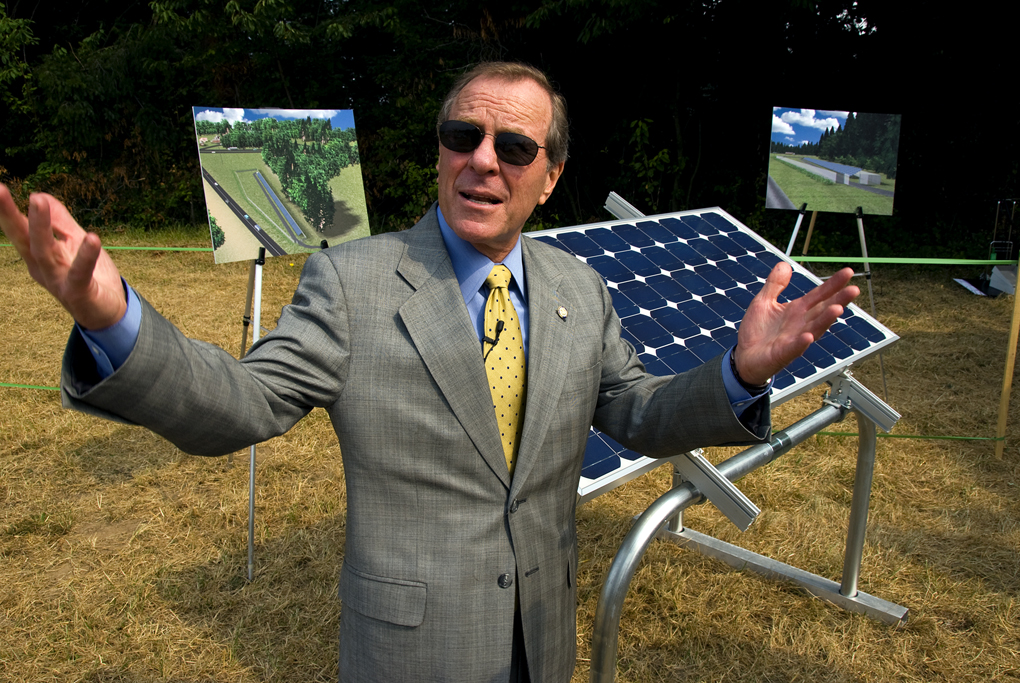
 This is a 104kW system, made up of 594 panels. Its annual production is estimated to be 128 megawatt-hours. This is enough to power over 10 typical homes' complete annual electricity use. However, the Oregon Dept of Transportation (ODOT) is using it to power the lights at the I-5 & I-205 exchange.
 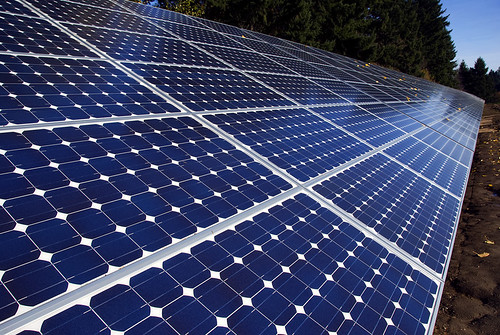 If ODOT is able to switch to more efficient bulbs in the future, these PV panels will become an even bigger percentage of their power needs.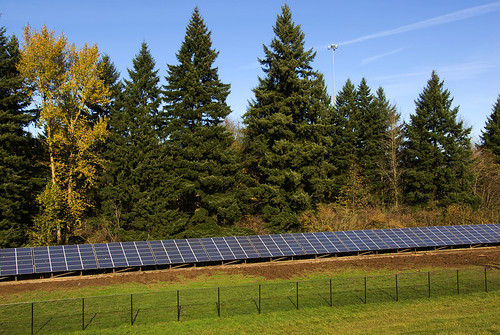

 This pilot program has gone well and is likely the first of many to come. Expect to see more solar panels along the highways of Oregon and possibly even on other ODOT facilities.
 Friday, February 6, 2009
2008 Solar Powered Driving
I started EV driving in Feb 2007 and then later that year in November our solar panels powered on. So 2008 was the first complete year that we had both an EV and the PV. Looking at the gold line in the graph, you can see in the above graph that my driving was net zero early in July.
Wednesday, February 4, 2009
Plug-ins may get cut from fed stimulus

From Plug-in America:
This year Plug In America, along with a team of entrepreneurial electric vehicle companies from coast to coast has worked with Senators Maria Cantwell (D-WA), Orrin Hatch (R-UT), John Kerry (D-MA), Debbie Stabenow (D-MI), and Bill Nelson (D-FL) to get critical plug-in vehicle tax credit language into the upcoming stimulus bill. We are very close to success!
But now our efforts are threatened - we hear that the tax credits for all plug-ins and plug-in hybrid conversions may get removed from the stimulus bill.
We need your help - and we will do most of the work. Please take just a moment to click through the link below and send a strong message to your representatives in Congress and the President telling them that you want plug-in electric vehicles to be successful along with the truly green jobs they can create. Show Washington just how serious you are about wanting affordable plug-in vehicles on the road now:
http://www.pluginamerica.com/stimulus
It is time to ask Congress to advance the next generation of transportation options. Each and every voice they hear will make a difference.
Let us do the work for you - Just click the link below and in less than a minute you can get your message to Congress about this key issue:
http://www.pluginamerica.com/stimulus
Thank you!
Jay Friedland
Legislative Director
Plug In America
Tuesday, February 3, 2009
A Green Federal Recovery Bill? With Your Help It Will Be.
 |
The sun came up this morning, ready to help. How about Congress?
Congress is in the midst of debating an economic recovery bill that could funnel billions towards jumpstarting our domestic renewable energy economy. Can you take action to make sure that the solar provisions are as strong as possible?

Since solar creates more jobs per megawatt than other energy resources and projects can be up and running within months, it is an obvious economic recovery tool. Last week, the House passed a version of the stimulus bill with $32 billion in clean energy funding. This week, the Senate takes up the debate, and the current Senate version of the recovery bill is missing several key solar provisions. Our friends at the Solar Energy Industries Association have put together a handy guide detailing the solar provisions that need to be included in The Recovery Act. Check it out here.
If added to the final bill, these solar provisions-from a renewable energy grant program, to putting solar on federal buildings to a manufacturing tax credit--will help create close to 200,000 new jobs and install 3 gigawatts of solar over the next 2 years.
Take action here.
Onwards,
Annie + Vote Solar Team
Oil On Ice